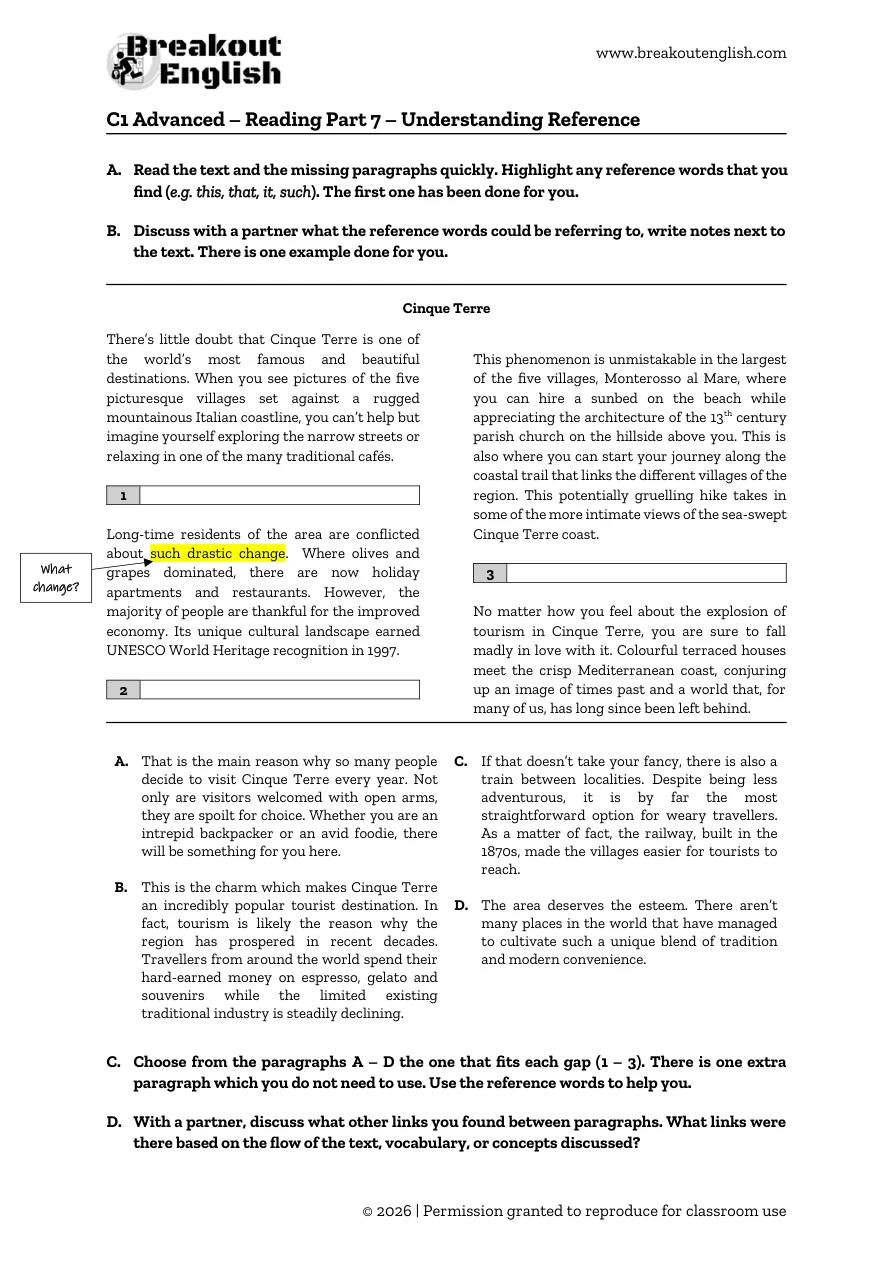
C1 Advanced Reading Part 7 is unquestionably one of the most time-consuming and difficult parts of the Reading paper. Even though Cambridge C1 Advanced candidates may have experienced the Gapped Text at lower levels, in C1 Advanced it takes on a much more difficult and challenging form. In this post we will examine the task itself and discuss ways to prepare for it. At the end, there are some materials that will help you prepare for C1 Advanced Reading Part 7 through understanding reference in a mini-task about one of my favourite parts of the world, Cinque Terre, Italy.

What is C1 Advanced Reading Part 7 - gapped text?
It’s a long text which has had 6 paragraphs removed from it. The candidate’s task is to fit those 6 paragraphs into the text in the correct place. 1 extra paragraph has been added which is not used.
The gapped text task tests the C1 Advanced candidate’s knowledge of the overall structure of a text as well as the linguistic devices which bind a text together. In order to complete the task successfully, candidates must analyse both the macro and microstructure of the text through an understanding of general flow of discourse throughout combined with the local structure of words, phrases and paragraphs.
Tips and tricks for C1 Advanced Reading Part 7
Unfortunately, there is no 100% foolproof trick to guarantee easy completion of C1 Advanced Reading Part 7. It requires time, thought and a lot of practice. However, there are a few techniques that you should be using to ensure quicker and more accurate answers.
- Give yourself enough time to complete this task. I find it can take up to 20 minutes of your exam time.
- Read through the complete text very quickly first. You should have a general idea of the topic and style of the text before starting. This shouldn’t take longer than a couple of minutes.
- Focus on the paragraphs before the main text. As you read through them, underline reference words (e.g. this, it, they) and linking words (e.g. however, additionally). See more about understanding reference below.
- After reading the paragraphs, start reading the text. Read the first paragraph and the paragraph that follows the first gap.
- There are three elements to consider:
- the macrostructure of the text (logical beginning, middle, end)
- grammatical links between paragraphs (reference and linking words)
- lexical links between paragraphs (synonyms)
- Check that your chosen paragraph fits the overall meaning and structure of the text, with clear links to the paragraphs on both sides of the gap. A gut feeling can help you here, but it shouldn’t be the only reason you choose an answer.
- Work systematically through the text paragraph by paragraph.
- If you aren’t sure of a paragraph, work to eliminate wrong answers and write down which ones you eliminated. This way, when you come back to it later, you have fewer options to choose from.
- After choosing an answer, read through the preceding paragraph, the paragraph you chose and the following paragraphs in order. Do they sound correct together?
- Keep up the pace. There is a huge risk of spending too much time on this task, which will hurt you in other parts of the exam.
Understanding reference

Reference is an important source of clues in C1 Advanced Reading Part 7. The gapped text fits into place like a jigsaw puzzle, and reference words can help you connect the pieces.
Reference words are anchors that connect one part of a text with another. They are often used to avoid repetition and to improve the flow of a text. Let’s look at a few different types of reference words:
- subject/object pronouns (I, he, she, it, they, him, her etc.)
- possessives (his, her, their etc.)
- words introducing relative clauses (which, who, where etc.)
- determiners (this, that, those, these, such)
- substitution of nouns with one, ones
- substitution of verb phrases with so
- linking words (however, furthermore, too etc.)
As you read through the missing paragraphs and the long text, you should underline or highlight every reference word.
Take a look at this sample paragraph and find the reference words:

The materials
These materials are designed to give insight into the technique needed to complete C1 Advanced Reading Part 7. This classroom mini-task has three gaps and four paragraph options, including one extra paragraph.
The mini-task format is to make it more usable in class as a training tool. It does make the task easier than an authentic C1 Advanced task, but it allows you to focus on technique rather than dealing with other language issues at the same time.
I recommend following up with a gapped text from a real C1 Advanced exam either in class or as homework.
EXAM PART: C1 Advanced Reading Part 7 – Gapped Text
EXAM SKILLS: Understanding reference
TIME: 45-60 minutes
PREPARATION: One copy of the worksheet per student
Procedure
- Introduce the topic by asking students what their favourite holiday destination is and why.
- Tell the students that you are going to read a text about Cinque Terre in Italy and ask if anyone knows anything about it.
- Work as a class with the students on one paragraph to highlight reference words.
- Students work together to highlight reference words in the rest of the text.
- Students then work together to choose the correct paragraphs.
- Discuss the use of reference after completing the task. Use the coloured, highlighted answer key to show reference.
- Follow up with a discussion about tourism and the advantages and disadvantages it has for an area like Cinque Terre.
Download

Preview

That was unbelievably helpful. Quite frankly without your help, I was facing the real danger of failing this part. Huge thanks to this site!
Thanks Nikolai! Very happy to help. 👍
Very useful! Cheers! Passed it on to my students
Thank you very much! Absolutely helpful for both, teachers and students!