
Fixed expressions are one of those areas of English that can feel easy until you have to use them yourself. You recognise the phrase in a text, understand what it means and move on. Then it turns up in a key word transformation and you can’t quite remember which preposition goes where. Familiarity only gets you so far. For Cambridge C1 Advanced, you need to recognise these expressions and use them accurately. We’ll look at what fixed expressions are, how to make them part of your active vocabulary and how to practise with the worksheet below. You can use it to study independently or as part of an exam preparation class.

Contents
What is a fixed expression?
A fixed expression is a familiar combination of words that we learn and use together. Knowing the individual words isn’t always enough. You also need to know how they fit together and what the whole expression means.
Examples include:
- Could you keep an eye on my bag? (watch or look after it)
- It came as no surprise when she got the job. (it was expected)
- It’s only a matter of time until they find out. (it will happen eventually)
- Without more practice, he won’t stand a chance of winning. (have a realistic possibility)
The word fixed doesn’t mean every expression stays exactly the same in every sentence. You can change the tense in make up your mind, or use make up her mind for a different person. Some expressions also allow other variations. However, you can’t freely swap words for synonyms and expect the phrase to sound natural.
Learn the pattern as well as the meaning. For example, stand a chance of is followed by a noun or an -ing form: She stands a chance of getting the job. That little preposition is worth remembering.
What’s the difference between a fixed expression and an idiom?
An idiom has a meaning that isn’t obvious from its individual words. If someone lets the cat out of the bag, they’ve revealed a secret. There doesn’t need to be a cat involved.
The categories overlap. Many idioms are fixed expressions too, including keep an eye on. Other expressions, such as by the time, have a more straightforward meaning. For exam preparation, the useful question is whether you understand the expression and can use it correctly in context.
Why are fixed expressions useful for C1 Advanced?
Fixed expressions can help across the Reading and Use of English paper:
- Part 1: Recognising a phrase can help you choose the correct word in the multiple-choice cloze.
- Part 2: A gap in the open cloze may be a missing word within a fixed phrase.
- Part 4: Key word transformations can require you to express the same idea using a different phrase or structure.
They are also useful in speaking and writing, provided they fit what you want to say. Be careful with register. An expression that sounds natural in a conversation may be less suitable in a formal report.
For some focused exam practice, try our C1 fixed expressions key word transformations.
How to make fixed expressions stick
Unfortunately, recognising an expression once doesn’t mean you’ll remember it next week. You need to see it, think about it and use it again. A long list can be useful, but staring at it hopefully isn’t much of a study plan.
- Learn the whole phrase. Include its preposition and any important grammar, such as there is no point in + -ing.
- Keep an example. Copy a sentence that makes the meaning clear, then write one connected to your own life.
- Test your memory. Cover part of the expression and complete it. Check afterwards, especially the small words.
- Notice it elsewhere. Look for expressions in reading texts, listening tasks, films and series. Record the context too.
- Come back to it. Review a small selection regularly and try using it in a new sentence or conversation.
Start with a manageable number. You don’t need to learn the entire worksheet in one sitting, and it isn’t a complete list of everything that might appear in the exam.
The materials
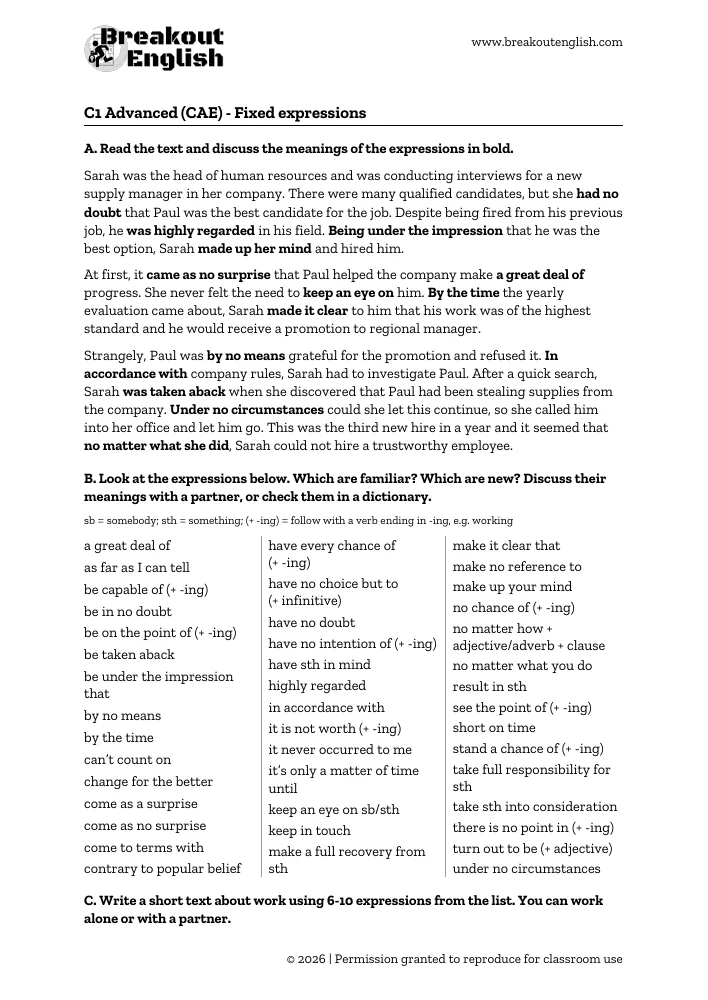
The worksheet includes a short text about recruitment and work, with fixed expressions in bold. Below it, there’s a longer list of expressions to discuss and study. The final task asks you to write a short text about work using 6-10 expressions.
Using the worksheet for independent study
- Read the text and check that you understand the story before focusing on the expressions.
- Explain each bold expression in your own words. Check unfamiliar meanings and patterns in a learner’s dictionary.
- Choose a few expressions from the list and write your own examples. Check how the surrounding grammar works.
- Complete the writing task. Afterwards, check each expression’s form and whether it fits your meaning.
- Return to your examples another day and see how much you can produce without looking at the list.
Using the worksheet in class
My preferred way to use these materials is a dictogloss. Students listen to the text, take brief notes and work together to reconstruct it. Comparing their version with the original gives them a reason to notice the expressions.
- Introduce the topic of work with a few questions about jobs, interviews or what makes a good employee.
- Read the text aloud while students listen without writing. Let them compare what they understood.
- Read it again while students note key words. Remind them that they aren’t trying to write down every word.
- In pairs or small groups, students reconstruct the text. Read it again if they need more support.
- Hand out the worksheet. Students compare their versions with the original and discuss the bold expressions.
- Look at a selection from the list, then complete the writing task in pairs using 6-10 expressions.
- Finish with feedback on good examples and errors. As an extension, students read their texts to another pair, who identify the expressions they hear.
If the full list is too much for your group, start with the expressions in the text. You can also use expression cards for true-or-false personal sentences or match expressions with their meanings. Keep recycling the language in later lessons so that it becomes something your students can actually use.
EXAM PART: Reading and Use of English
EXAM SKILLS: Recognising and using fixed expressions accurately
LEVEL: C1 Advanced
TOPIC: Work
TIME: 60-90 minutes for the classroom procedure, plus homework or extension
PREPARATION: One copy of the worksheet per student
Download

Preview

230 Key Word Transformations
Practise C1 Advanced Part 4 with 230 transformations in 23 grammar and vocabulary units, plus guidance and an answer key.
Digital PDF: €8.95 · Also available in paperback
