
Four minutes can feel very long when two people are talking and neither is listening to the other. That’s the biggest danger in B2 First Speaking Parts 3 and 4. You have to give your partner something to respond to, then listen to what they say back. If done right, this can be an interesting, engaging part of the exam. These materials will help you build a conversation and support your opinions so that both you and your partner can succeed in the B2 speaking test.

Contents
What happens in B2 First Speaking Part 3?
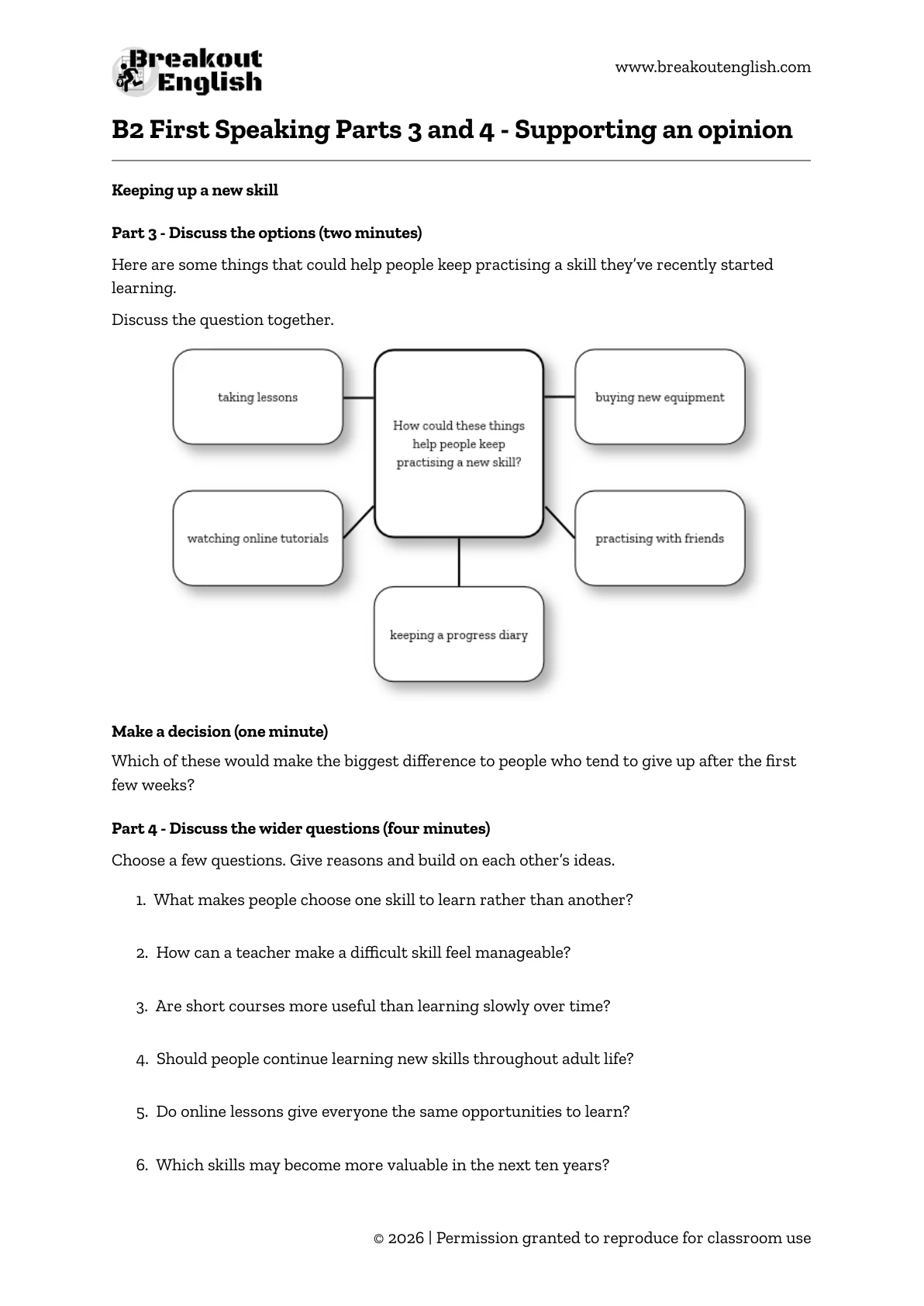
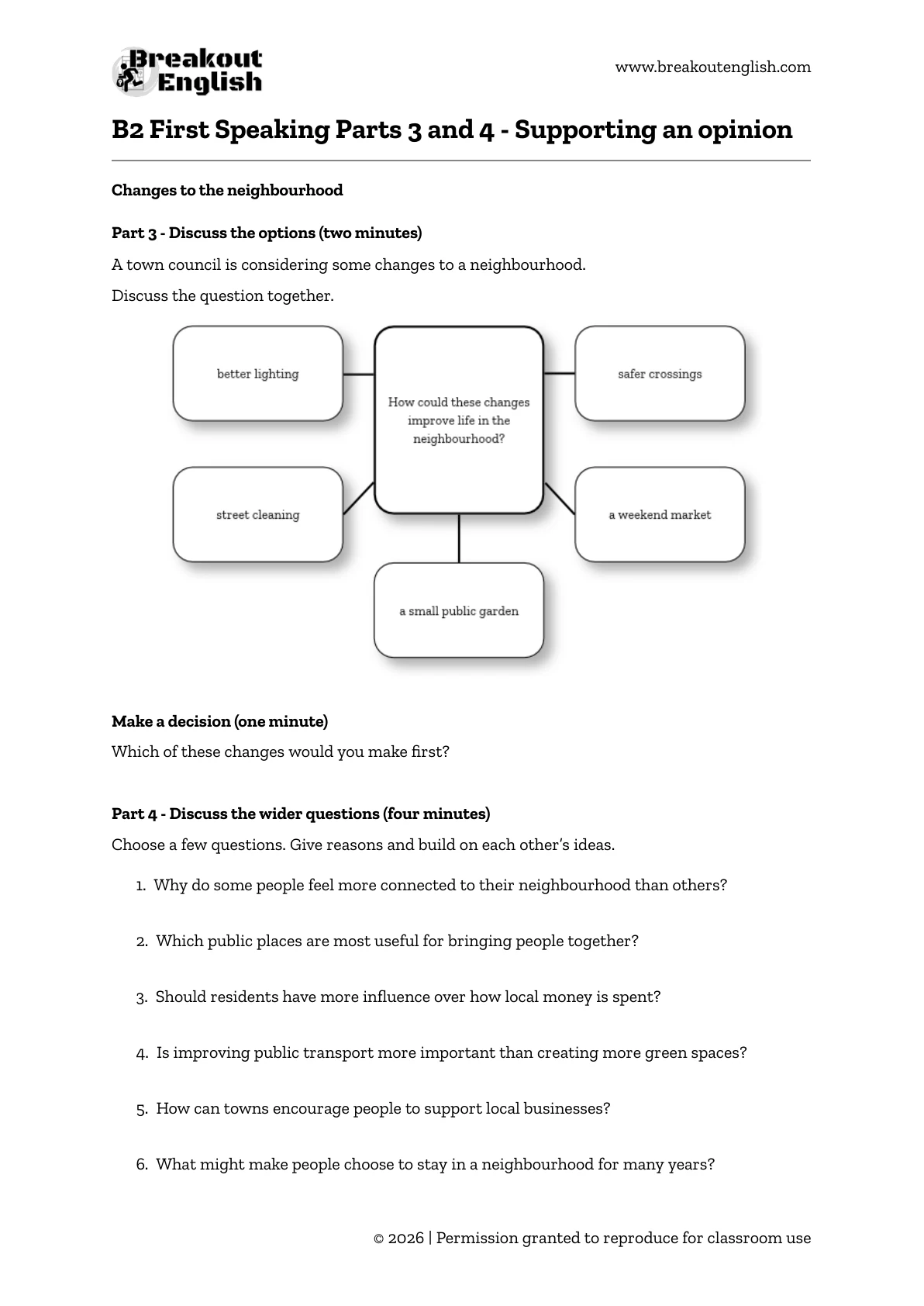
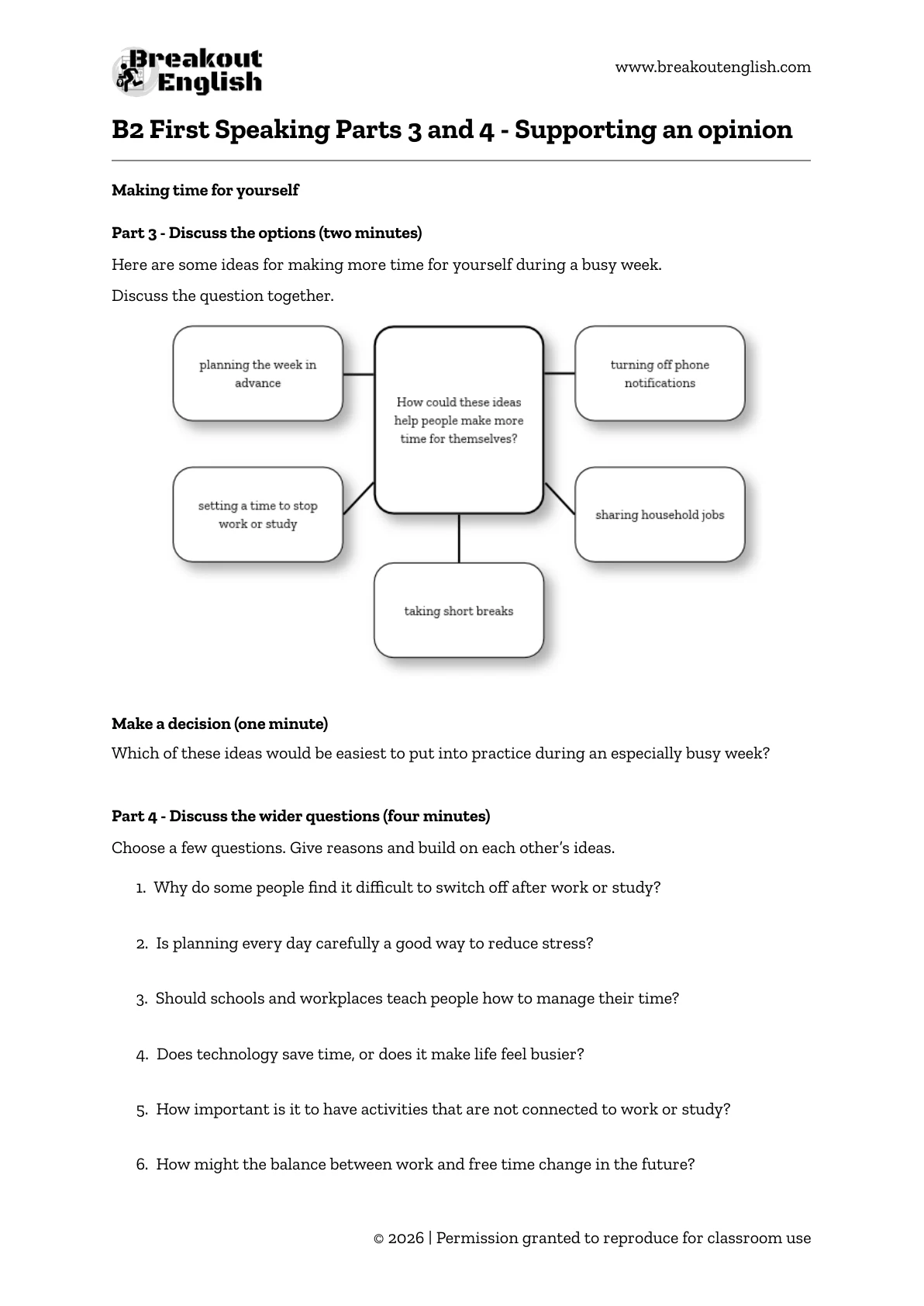
The examiner gives you and your partner a question with five written prompts. You have about 15 seconds to look at the diagram, then two minutes to discuss it together. The examiner then asks a second question and gives you one minute to work towards a decision. In both stages, you talk to your partner.
Imagine the diagram asks, What could friends enjoy about visiting these places on a day out? The prompts are a park, a museum, a cinema, a sports centre and a café. You could say, “A park would be good if we wanted to talk. What about the museum if it rains?” You can leave some prompts untouched and give a good idea time to develop. You don’t always need to speak about all five of the topics. Be careful you don’t start making decisions too early, but that’s what the second stage of Speaking Part 3 is about.
After your two-minute discussion, the examiner might ask, Which place would be best for friends who want to spend the whole afternoon together? Compare your choices and try to agree. If time runs out, it’s not the end of the world. The discussion you’ve had still counts.
This is a simple example to illustrate the format, but if you want to focus on Part 3, common topics and useful phrases, check out our materials on B2 First Speaking Part 3 useful phrases. If you want more diagrams to work through with a partner, try these B2 First Speaking Part 3 examples.
What happens in B2 First Speaking Part 4?
After three minutes, the examiner takes away the diagram and asks more questions on the same topic. The discussion lasts about four minutes in total for a pair. The examiner might ask one of you first or invite you both to answer. To answer, give your answer and a reason for your view and pick up on what your partner says. Don’t be afraid to ask your partner questions and bring them into the conversation. Take a look at this example.
Examiner: Do you think it’s better to plan a day out with friends in advance?
A: It depends what you want to do, but a lot of things you need to plan in advance. I’d book the cinema, for example. If it’s busy, you might turn up and find there are no seats left. And these days you definitely need to reserve a table in a restaurant, or you might not find a place to eat. It’s so busy everywhere! What do you think?
B: Good point. It’s true that planning in advance is often a good idea, but maybe not always. For a day out in the park, I’d wait and see what the weather was like.
Don’t forget that Part 4 is your last chance to impress. If you got stuck on the Part 2 pictures, a good discussion can lift your performance. If your Part 3 diagram was confusing, you can change the examiner’s mind by coming back in Part 4. However, a string of one-line answers or a pair of candidates with no interactive spark can take the shine off a good test. You’re assessed across all four parts, so stay involved until the end.
What is Interactive Communication?
Interactive Communication is one of the four criteria the assessor uses. It covers how you start a discussion, respond to what your partner says and keep the conversation going. In the example, B takes up A’s point about planning ahead and explains that they’d wait to see what the weather was like before making plans for the park.
It’s not only about what you say, but also how you say it. Turn towards your partner when you reply. If they’re quiet, ask a specific question like Would you still book tickets if only two of you were going? If they’re doing most of the talking, use a natural pause to come in with Can I add something about that?
Useful phrases for supporting an opinion
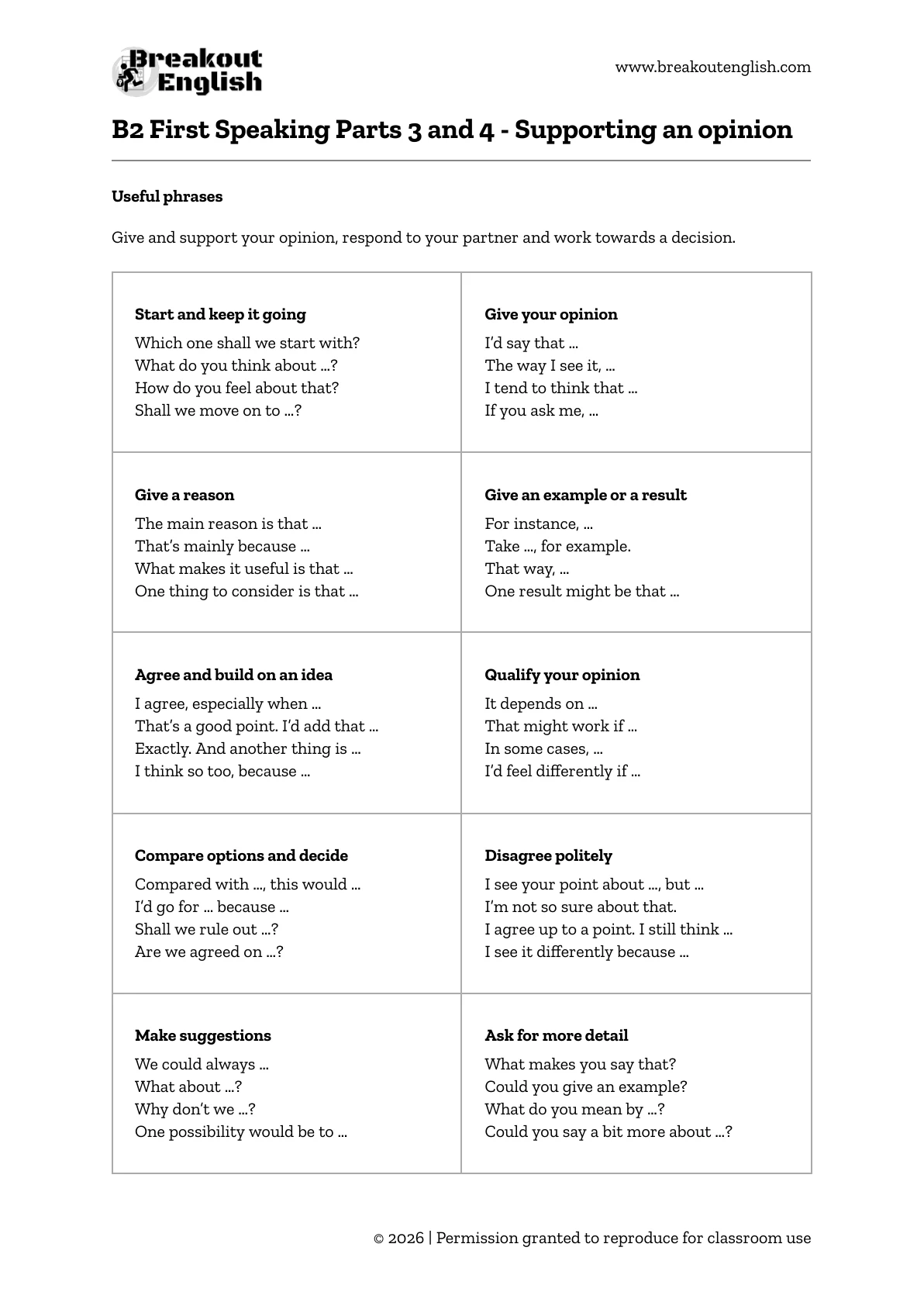
One of the things that always helps students is being prepared with plenty of useful phrases. The goal isn’t to use dozens of phrases with no sense or reason, but these phrases do help to control a conversation and demonstrate interactive communication.
The materials below are packed with useful phrases, just like you’ll find in some of our other posts and in our speaking books.
A classroom competition for useful phrases
I like making using phrases a competition. Put students in threes, with two speakers and one scorekeeper. The scorekeeper gives a point for each different phrase used by each partner that fits the conversation.
Then swap roles and try again. Repeat a couple of times, then turn over the phrase sheet and try from memory.
The materials
Choose from three packs, each with two one-page tasks. Rotate them around a classroom to give up to six speaking tasks. The Part 4 questions are printed alongside Part 3 for classroom use. The useful phrases sheet goes with all three packs. When you’re ready to practise all four parts together, see our B2 First Speaking sample tests.
EXAM PART: B2 First Speaking Parts 3 and 4
EXAM SKILLS: Supporting opinions, developing a discussion and negotiating a decision
LEVEL: B2
TOPIC: Learning something new, improving a neighbourhood, and work, study and free time
TIME: 20-25 minutes per task
PREPARATION: One practice sheet per pair and a copy of the useful phrases reference sheet
Download

Preview

5 Speaking Tests
Try five complete B2 First Speaking tests covering all four parts, with examiner scripts and visual materials for classroom or partner practice.
Digital PDF: €3.95 · Also available in paperback
