
Describing a picture is a familiar feature of Cambridge speaking exams because it’s something we do so much in everyday life (is it?). Whatever their reasons are for having such a deeply rooted love affair with describing pictures, there is no doubt that it is a skill you will have to learn for B1 Preliminary Speaking Part 2. Also, let’s be fair, it can be a pretty good way of testing your ability to organise your speech. In this part of the exam, you have approximately one minute to describe one colour photograph on your own. Your partner listens and then has a turn with a different photograph.

Contents
What type of picture will be used?
Unlike B2 First, you don’t have to compare two photographs or answer a question about why people have chosen to do something. The examiner introduces the topic and asks you to describe what you can see. That can be a good thing because Cambridge has a knack for odd questions, but a whole minute of describing can still strike fear into the heart of budding exam candidates.
The photographs show people in everyday situations. Their actions, clothes, surroundings and the objects in the foreground and background give you content for your description.
Take a look at the two pictures below. Both are on the topic of food and cooking, but the simple food photograph gives you very little to talk about. The one with people and a scene is much better for practising a one-minute description.


A plan for describing a picture
The worksheet gives you five things to look for. You don’t need to say everything you can see. Use the plan to organise the details you choose.
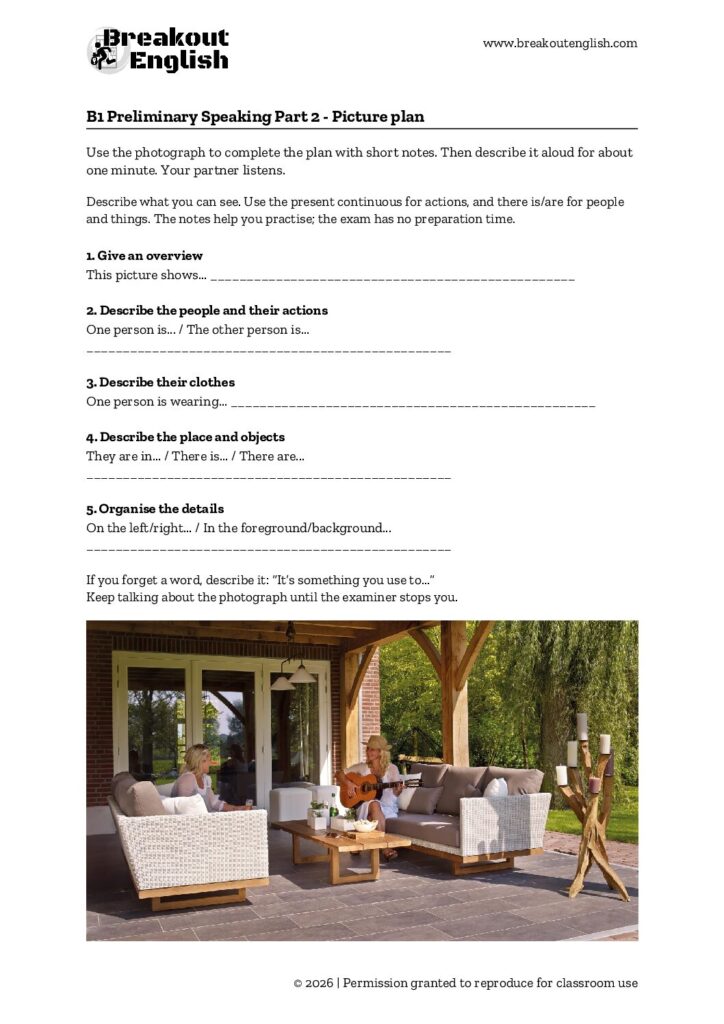
- Give an overview. “This picture shows two people sitting outside.”
- Describe the people and their actions. “One person is playing a guitar and the other person is listening.”
- Describe their clothes. “The person on the left is wearing a light-coloured top.”
- Describe the place and objects. “They are on a terrace. There is a small table between them.”
- Organise the details. “In the background, I can see some trees.”
These examples follow the photograph in the worksheet. Join your ideas with and, but and because.
How can I prepare for this part of the exam?
Preparation comes in two ways. First, be confident with the grammar: present continuous for actions (“Someone is cooking”), there is/are for people and things, and quantifiers such as some and a lot of. Second, structure your answer using the plan.
Start with short notes, say your description out loud and time yourself. Can you keep it going for a minute? Repeat with less support, then try a new photograph straight away. There is no preparation time to write notes in the exam.
If you forget a word, describe it another way: “It’s something you use to…” Keep talking about what you can see. A brief guess such as “They seem relaxed” is fine, but avoid inventing a story about the people.
The materials
The worksheet includes the five-stage plan, useful sentence starters and one photograph. For more pictures, check our pictures to describe for B1 Preliminary Part 2 post.
I’d recommend starting with this one and then using more pictures with less support. If you’re using them in class, I like to slowly remove the reliance on the written plan by having students turn it over on their desks after practising a couple of times.
We also have 5 complete B1 Preliminary Speaking exams as part of Breakout English’s premium materials collection.
EXAM PART: B1 Preliminary Speaking Part 2
EXAM SKILLS: Discourse management, describing a picture, using language appropriate for B1
TIME: 15 minutes + extra practice
PREPARATION: One copy of the worksheet per student, a timer and extra photographs
Download

Preview

5 Speaking Tests
Try five complete B1 Preliminary Speaking tests covering all four parts, with examiner scripts and visual materials for classroom or partner practice.
Digital PDF: €3.95 · Also available in paperback

Wonderful worksheet. It’s been quite helpful for my students!
Fantastic! So glad it was helpful 🙂