
These 120 C1 conversation questions cover 12 topics. Some are straightforward lead-ins; others raise more complex issues. Each topic also has evaluation and challenge prompts to help learners test assumptions, consider exceptions and support an argument.

Contents
C1 conversation questions
These C1 conversation questions cover 12 topics:
- Ambitions
- Independence
- Stereotypes
- Role models
- Competitiveness
- Young people’s rights
- The media
- Advertising
- Lifestyles
- The arts
- The rights of the individual
- Economic issues
As you can see, the topics at this level start to get quite complex and abstract. This is part of the challenge of speaking at C1 level: discussing different concepts, qualifying your views and considering other perspectives.
Remember, this should be a conversation. Ask your partner to explain their view and respond to what they say. Choose two or three lead-in questions, then try an Evaluate and a Challenge prompt. Finish by discussing whether your partner changed your view.
Don’t let students race through the questions. Take Should advertisers be allowed to target children? An initial answer might be “No, because children are easily influenced.” Their partner then has something to challenge: “Would you apply the same rule to an advert for books?” Encourage students to defend their position with reasons and examples.
Download a printable version of our 120 C1 conversation questions:
Download

Preview
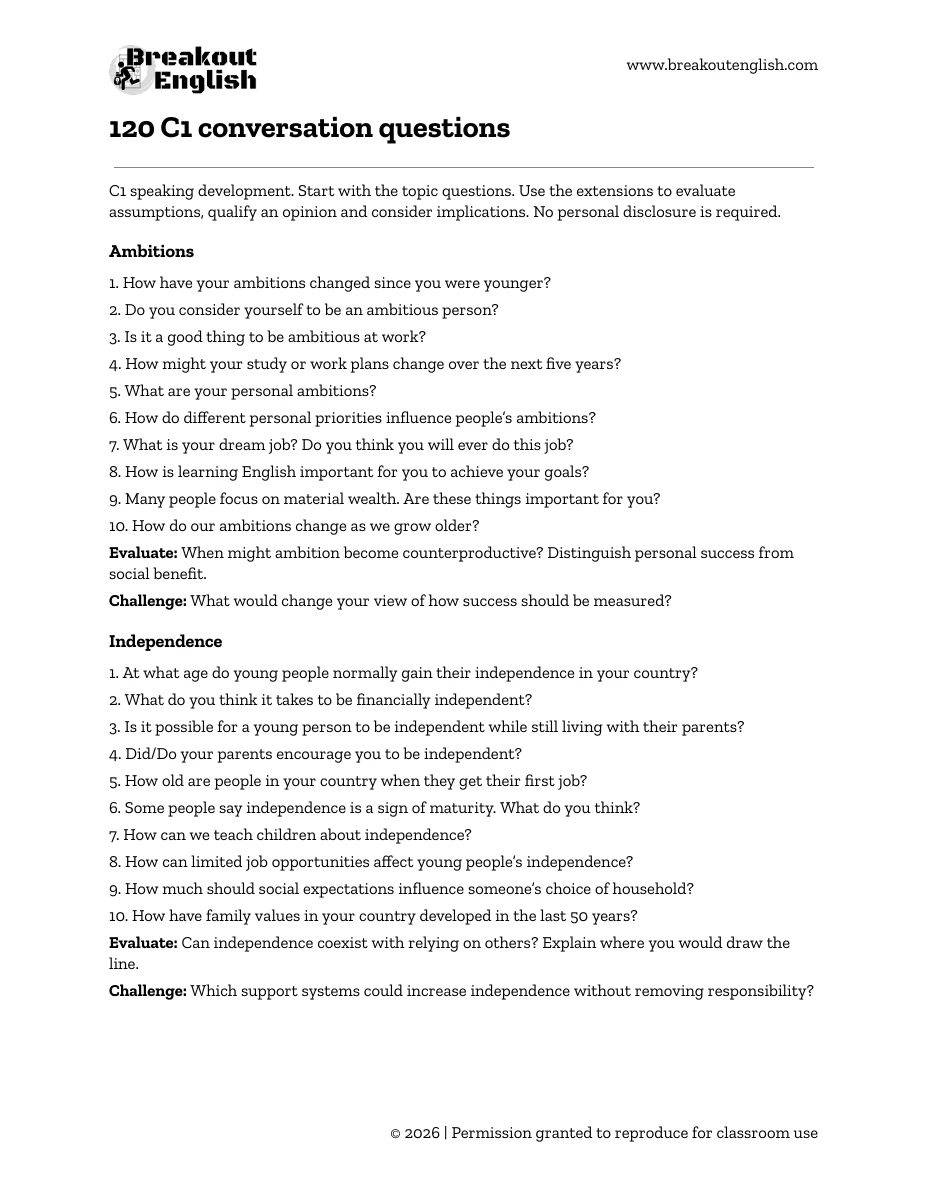
Ambitions
- How have your ambitions changed since you were younger?
- Do you consider yourself to be an ambitious person?
- Is it a good thing to be ambitious at work?
- How might your study or work plans change over the next five years?
- What are your personal ambitions?
- How do different personal priorities influence people’s ambitions?
- What is your dream job? Do you think you will ever do this job?
- How is learning English important for you to achieve your goals?
- Many people focus on material wealth. Are these things important for you?
- How do our ambitions change as we grow older?
Evaluate: When might ambition become counterproductive? Distinguish personal success from social benefit.
Challenge: What would change your view of how success should be measured?
Independence
- At what age do young people normally gain their independence in your country?
- What do you think it takes to be financially independent?
- Is it possible for a young person to be independent while still living with their parents?
- Did/Do your parents encourage you to be independent?
- How old are people in your country when they get their first job?
- Some people say independence is a sign of maturity. What do you think?
- How can we teach children about independence?
- How can limited job opportunities affect young people’s independence?
- How much should social expectations influence someone’s choice of household?
- How have family values in your country developed in the last 50 years?
Evaluate: Can independence coexist with relying on others? Explain where you would draw the line.
Challenge: Which support systems could increase independence without removing responsibility?
Stereotypes
- What are the typical stereotypes of your country abroad? Are they true?
- Are stereotypes always negative? Why / Why not?
- To what extent should we believe stereotypes of other countries?
- Does your town, city or region have any stereotypes inside your country? Are they true?
- Are stereotypes and prejudices the same thing?
- How do TV and films affect stereotypes?
- How do people in your country view the elderly?
- What is the current opinion regarding immigration in your country?
- How have stereotypes been significant in the history of your country?
- What is lost when an individual is described using a national stereotype?
Evaluate: How can a generalisation be useful without becoming a prejudice?
Challenge: How would you evaluate the reliability of a claim about a whole group?
Role models
- Who in your family did you look up to when you were a child?
- Did you have any celebrity role models when you were younger?
- What historical figure from your country is a good role model?
- Who has more influence as a role model for children: parents or teachers?
- For many people, their best friend is a role model. Is this true for you?
- What are the benefits and risks of children treating sportspeople as role models?
- What characteristics make a negative role model?
- Do you look up to anybody professionally?
- In your opinion, should public figures in your country be admired?
- Would you make a good role model for the younger generation?
Evaluate: To what extent should admiration depend on someone’s private behaviour?
Challenge: Could a flawed role model still be useful? Qualify your answer.
Competitiveness
- Are you a competitive person?
- Is being competitive in sports a good thing or a bad thing?
- Is it good to be competitive professionally? Why / Why not?
- Who is the most competitive person you know?
- Should we teach children to be competitive?
- Competition can be motivating for people when learning new things. Do you agree?
- International events like the Olympic Games promote competition between countries. Do you think this is a good thing?
- What happens when competitiveness goes too far?
- How important is it to be a good loser?
- Tell me about a time when you felt very competitive. Why did you feel this way?
Evaluate: When does competition improve performance, and when might cooperation work better?
Challenge: What evidence would help a school choose between competitive and cooperative activities?
Young people’s rights
- At what age is an individual considered an adult in your country?
- Should people under the age of 18 be allowed to vote in elections?
- Should different responsibilities have different age limits? Why?
- If a young person wants to live without their parents, should they be allowed to?
- How much control should a young person have over their education?
- At what age should we start letting young people make their own choices?
- Some countries have curfews for young people at night. Do you agree with this?
- Should teenagers who commit crime be punished in the same way as adults?
- At what age do you think it is appropriate for young people to start working?
- When might limits on a teenager’s freedom be reasonable?
Evaluate: How should decision-makers balance protection with young people’s autonomy?
Challenge: What might be the unintended consequences of giving young people more responsibility?
The media
- What is your preferred method of getting the news: newspapers, radio or TV?
- Is it important to stay up-to-date with current events?
- Do you prefer local news, national news or international news?
- Do you agree with everything you see on the news?
- How can a news organisation distinguish reporting from political opinion?
- What is your opinion about getting your news from social media?
- Should the media respect the privacy of famous people?
- What types of stories does the media in your country focus on?
- How can we avoid being influenced by news that isn’t accurate?
- Do you think newspapers are dying out due to the popularity of internet news?
Evaluate: How should a reader assess a claim when several reputable reports disagree?
Challenge: Should speed or accuracy take priority in reporting? Consider an exception.
Advertising
- How does frequent exposure to advertising affect people’s choices?
- When might an advertisement be inappropriate for its audience?
- Tell me about a memorable advertisement that you have seen.
- Should advertising for products that may cause harm be restricted?
- Do you believe what advertisements tell you?
- Why is advertising important for a company’s success?
- If you saw a product being advertised by a popular celebrity, would you be more likely to buy it?
- Should advertisers be allowed to target children?
- What are the benefits and risks of online advertisements being targeted at individuals?
- Do you think advertising influences your purchasing decisions?
Evaluate: Where should responsibility for misleading advertising lie?
Challenge: Would stricter advertising rules protect consumers or restrict useful information?
Lifestyles
- Do you feel like you live a relaxed or a stressful life?
- How does our relationship with our family affect our lifestyle?
- Do you think it’s necessary to have a lot of money to be happy and live a good life?
- Some people are risk takers in life. Are you? Why / Why not?
- How do changes in household structures affect communities?
- How important is it to have a healthy lifestyle?
- What should people in your country do to improve their lifestyle?
- Is it essential to have lots of friends to be happy?
- Why do some people choose to live outside society?
- How has your lifestyle changed since you were younger?
Evaluate: How much control do people have over their own lifestyles? Consider practical constraints.
Challenge: Which lifestyle change could have benefits for both individuals and communities?
The arts
- What type of art do you prefer? Why?
- Tell me about a famous artist from your country who you like.
- Do you like modern art or do you prefer more traditional art styles?
- Are you an artist? What type of art / Why not?
- Is it easy to become a successful artist? Why / Why not?
- Some art is worth a fortune. How do you feel about this?
- What is the most memorable performance you have ever seen?
- Do people in your country tend to appreciate art?
- Who decides which forms of art are valued most highly?
- Is music art? What about dance? Poetry? Graffiti?
Evaluate: Should public funding favour popular art or work that challenges its audience?
Challenge: What might be lost if artistic value were judged only by price or popularity?
The rights of the individual
- Do you believe in the universal right to vote in a democracy?
- What rights do workers in your country have?
- Are there enough maternity and paternity rights for new parents in your country?
- Freedom of speech is a right in many countries. Should this include all types of speech?
- Should everybody have the right to quality healthcare?
- How can we protect people in other countries who are denied rights that we would consider essential?
- Should criminals enjoy all the same rights as other citizens?
- In what situations is it acceptable to restrict our individual rights?
- Does the government have the right to use our personal information to protect us?
- What responsibilities do consumers and companies have when workers are exploited?
Evaluate: When can protecting a community justify restricting individual freedom?
Challenge: What safeguards would make such restrictions more acceptable?
Economic issues
- In what ways do we contribute to the economy as individuals?
- What is the most important export in your country?
- Are you worried about the levels of unemployment in your country?
- What should governments consider when deciding how to raise public funds?
- Do governments have responsibility to send aid to countries with weaker economies?
- What can make it difficult for young adults to find suitable housing?
- Tell me about an important company from your country.
- What is your opinion about clothing companies using cheap labour to produce clothes?
- Some companies are worth billions. Is it possible for companies to be too big?
- How has technology and the internet affected the global economy?
Evaluate: How should economic success be measured beyond growth?
Challenge: Who might gain or lose from a policy that appears beneficial overall?

Advanced Speaking Plus
Preparing for C1 Advanced? Work on useful Speaking language and approaches to all four parts, then put it into practice with five complete tests.
Digital PDF: €9.95 · Also available in paperback

Thank You!!!!