
Dilemmas and opinions can make for an interesting discussion, especially when your students don’t all agree. These C1 speaking activities give advanced learners 20 prompts to explore, from difficult personal decisions to opinions worth challenging.

Contents
Using dilemmas and opinions for C1 speaking
Ask students to take a position and defend it. Sitting on the fence can leave everyone agreeing that the issue is complicated without saying very much about it. If necessary, assign opposing views. Students don’t have to believe what they’re arguing.
Introduce the language first
Before giving out the prompts, introduce a few phrases for agreeing and disagreeing.
Agreeing
- I couldn’t agree more.
- That’s exactly how I see it.
- You’re absolutely right about…
Disagreeing
- I completely disagree.
- I’m afraid I can’t agree with you there.
- I’d challenge the idea that…
Model an exchange and ask students to add a reason or example after each phrase. An enthusiastic “I couldn’t agree more” still needs something behind it.
For more language practice before the discussion, try our agreeing and disagreeing activity.
Dilemma prompts
Give partners different solutions to defend. In the shared-house dilemma, one could argue for keeping parties at home while the other insists they should move elsewhere. Ask them to question each other’s suggestions before trying to agree on a fair arrangement.
“I’m afraid I can’t agree with you there. It’s everyone’s home, so one person shouldn’t get to decide how the others spend their weekends.”
Opinion prompts
Ask one student to support the statement and the other to oppose it. With the claim that online communication weakens relationships, a response could be:
“I completely disagree. My closest friend lives abroad. Without video calls, we’d barely see each other.”
Their partner now has an argument to answer. After the discussion, let students reveal their actual opinions and say which arguments they found convincing.
The materials
There are ten dilemmas and ten opinion prompts for C1 speaking practice. Use one as a warmer or give pairs different prompts, then ask them to share their recommendations or disagreements.
For more topics, try our C1 discussion and argument questions.
Download

Preview
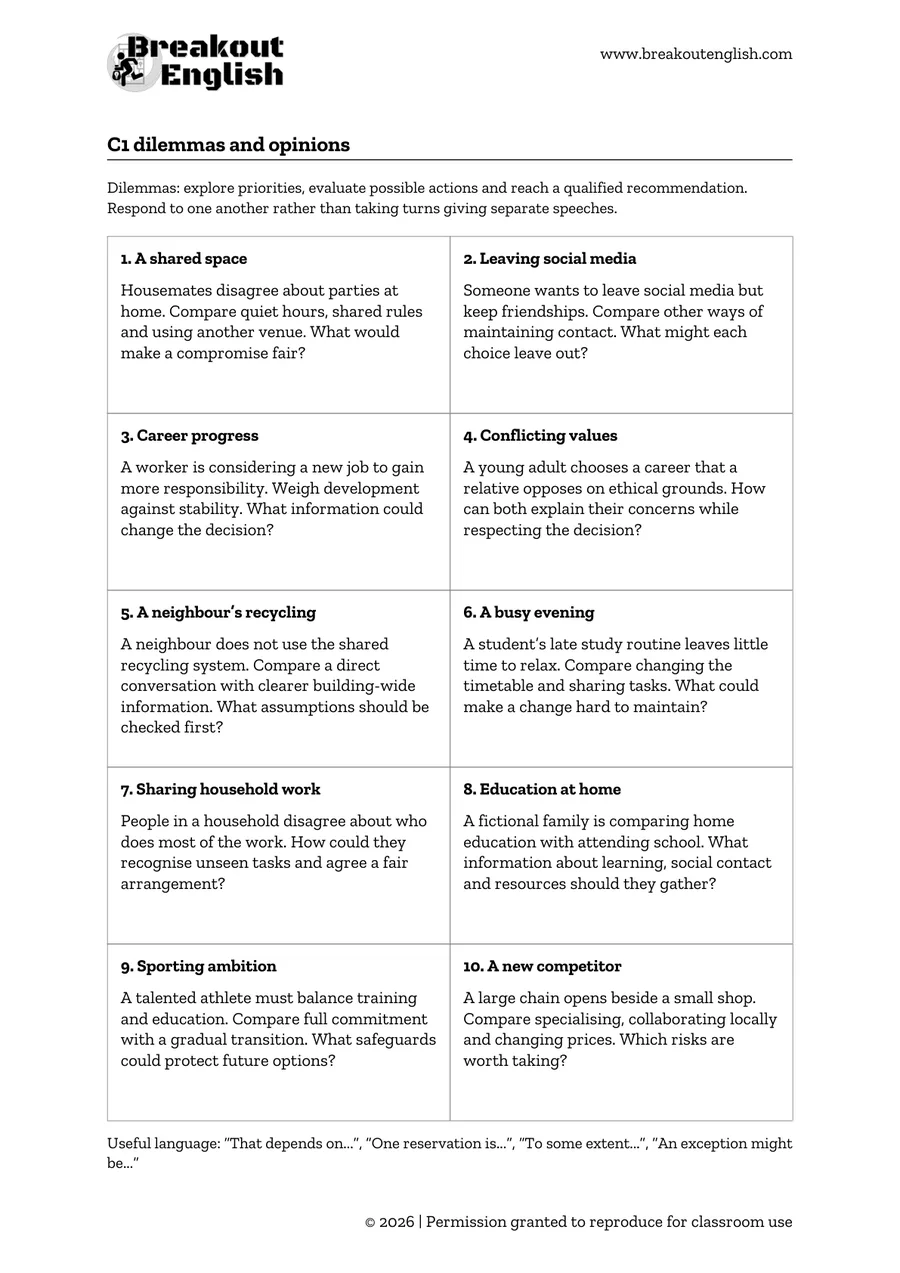
Dilemma prompts
- Housemates disagree about parties at home. Compare quiet hours, shared rules and using another venue. What would make a compromise fair?
- Someone wants to leave social media but keep friendships. Compare other ways of maintaining contact. What might each choice leave out?
- A worker is considering a new job to gain more responsibility. Weigh development against stability. What information could change the decision?
- A young adult chooses a career that a relative opposes on ethical grounds. How can both explain their concerns while respecting the decision?
- A neighbour does not use the shared recycling system. Compare a direct conversation with clearer building-wide information. What assumptions should be checked first?
- A student’s late study routine leaves little time to relax. Compare changing the timetable and sharing tasks. What could make a change hard to maintain?
- People in a household disagree about who does most of the work. How could they recognise unseen tasks and agree a fair arrangement?
- A fictional family is comparing home education with attending school. What information about learning, social contact and resources should they gather?
- A talented athlete must balance training and education. Compare full commitment with a gradual transition. What safeguards could protect future options?
- A large chain opens beside a small shop. Compare specialising, collaborating locally and changing prices. Which risks are worth taking?
Opinion prompts
- “Traditional family life was better.” What assumptions does this claim make? Consider different household structures and generations.
- “People would be happier if they slowed down.” Which practical constraints might prevent this? Distinguish preference from necessity.
- “Hosting a major sports event benefits everyone.” Who might gain or lose? Suggest a way to assess the overall impact.
- “If you have nothing to hide, online privacy does not matter.” Challenge the assumptions and consider legitimate uses of personal data.
- “Sensational headlines make news impossible to trust.” What evidence would help assess this? Consider reporting, headlines and opinion separately.
- “Online communication weakens real relationships.” Under what conditions might the opposite be true? Qualify your conclusion.
- “New technology always improves our lives.” Compare benefits, unintended effects and unequal access.
- “Wanting to win is the best motivation.” When could that help or harm a group? Propose a balanced approach.
- “A strong school system is the best investment in the future.” What should it aim to achieve, and what other investments might be needed?
- “Young adults should leave home as soon as possible.” How do cost, culture and personal circumstances affect this view?

Advanced Speaking Plus
Preparing for C1 Advanced? Work on useful Speaking language and approaches to all four parts, then put it into practice with five complete tests.
Digital PDF: €9.95 · Also available in paperback
