Learning how to write a proposal for the Cambridge C1 advanced exam sometimes seems like an afterthought. You’ve probably spent plenty of time practising essays, letters/emails feel familiar, a review is something we see in everyday life (at least short ones online), and you may have written reports at B2, but proposals need a slightly different approach. The headings and formal language seen in model answers remind us of a report. However, the purpose is rather different. With a proposal, your challenge is to persuade someone that your suggestions are worth following, which gives you quite a bit of freedom to come up with ideas of your own. Once you understand what you’re trying to achieve, a proposal can actually be an enjoyable thing to write and potentially one of the most interesting writing types in the exam.

Contents
What is a proposal?
A proposal puts forward suggestions for someone to consider and explains why they would be useful. You might be asked to recommend improvements to your local area, suggest activities for an event or find a new solution for a problem. The reader will usually be someone who can approve your ideas such as the town council, so you need to think about the decision from their point of view.
For example, imagine that a school library has asked for suggestions for an unused area. You’d quite like some rooms where you can work with your friends. That’s a reasonable starting point, but the school is responsible for everyone who uses the library, so let’s not make it personal. Explaining that separate rooms would let groups work together without disturbing other readers gives your suggestion a much stronger justification than saying you want it for you and your classmates.
This combination of practical information, evaluation and persuasion is what you’re aiming for. The reader needs to understand what you’re suggesting and why it’s worth doing.
In C1 Advanced Writing Part 2, a proposal is one of the text types you may be offered. You choose one of three questions and write 220–260 words. The question tells you who you’re writing for and what you need to include. Our C1 Advanced Writing guide covers the other options.
How is a proposal different from a report?
It’s easy to confuse the two, especially if you’ve learnt a four-paragraph plan for both. They can have almost the same structure: an introduction, sections with headings and a final recommendation. Changing report to proposal in the first sentence, however, won’t necessarily give you the right text.
A report presents and evaluates information. A report about the library might explain how the study areas are used, identify problems and recommend improvements based on those findings. A proposal would develop the suggested improvements themselves, explaining how they could work and why the headteacher should approve them.
There is some overlap. Reports can recommend future action, and proposals may need to describe an existing problem. What matters is the purpose of the details you include. If you spend most of your proposal describing the library as it is now, you’ll have very little space left to develop your suggestions. Keep the background brief and concentrate on what you want to change. You can compare this with the examples in our guide to writing a report.
Formal and persuasive language
A proposal normally calls for a formal style, particularly when you’re writing to a local council, manager or college principal. Use full forms such as would not instead of wouldn’t, and choose language that would be appropriate in a professional setting. A proposal for fellow club members might be more neutral, so always check the reader in the question, but generally formal is the way to go.
The difficulty is keeping that formal tone while sounding positive about your ideas. Calling something amazing or saying that everyone will love it is unlikely to help much. You can be more convincing by explaining a specific benefit. Compare these two sentences:
Basic suggestion
We should have more rooms where we can study for our exams.
Persuasive suggestion
Additional study rooms would enable students to collaborate without disturbing other readers.
The second sentence gives the headteacher a reason to agree. It also shows that the writer has considered a possible problem: noise. That’s useful persuasion in a proposal, and it doesn’t depend on exaggerated claims or particularly complicated vocabulary.
You can acknowledge disadvantages too. A suggestion doesn’t become less persuasive just because you admit that it would take some organisation. If you explain how that difficulty could be managed, the reader has less reason to reject it.
Useful language for proposals
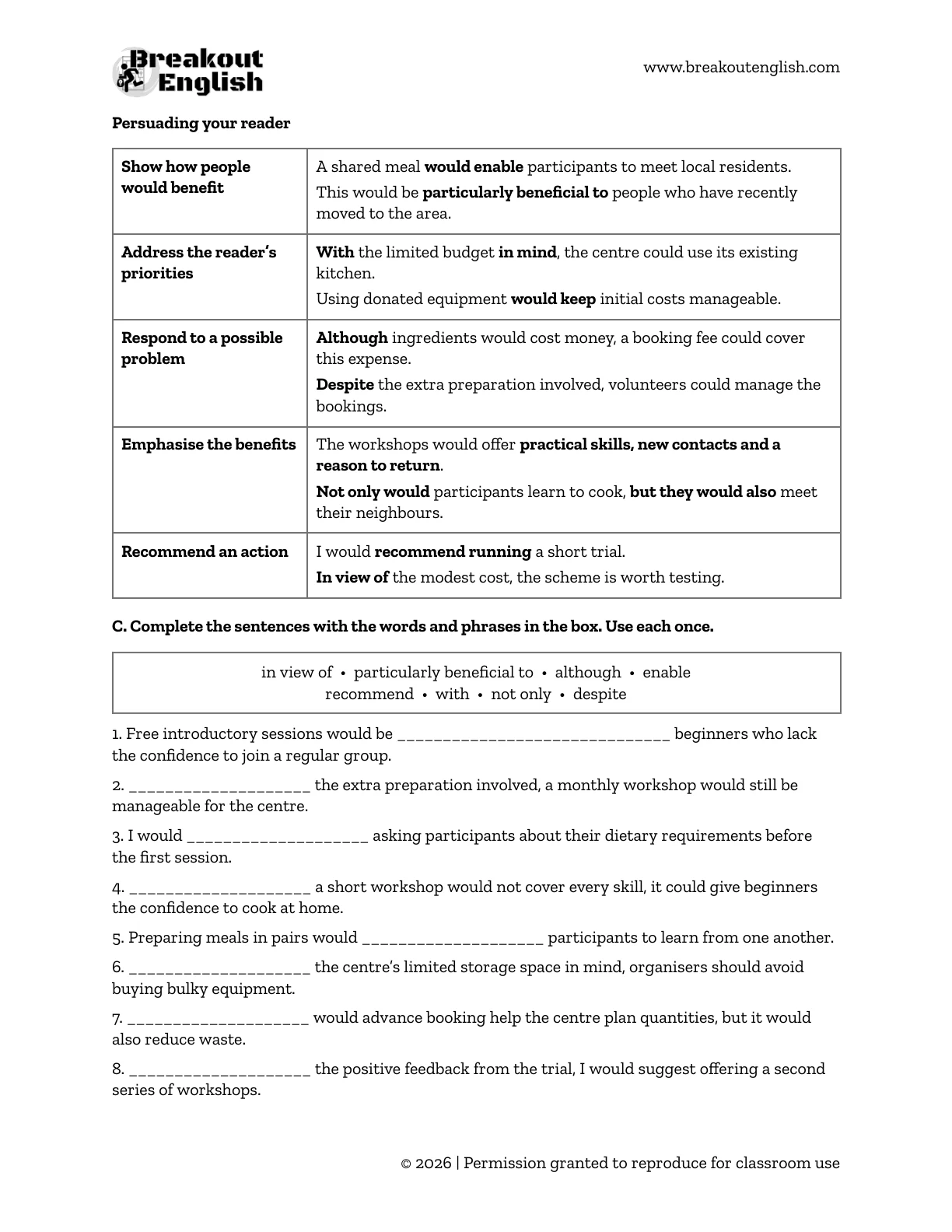
When learning phrases for proposals, pay attention to what they help you express. You’ll get more use out of would enable someone to do something if you practise connecting a suggestion to a benefit than if you simply add it to a list of formal phrases.
| Function | Example |
|---|---|
| Connect an action to a benefit | Additional study rooms would enable students to collaborate without disturbing other readers. |
| Appeal to the reader’s priorities | Using existing furniture would keep the initial costs manageable. |
| Anticipate an objection | Although coordination would require staff time, an online booking system would lighten the load. |
| Add emphasis | The study rooms would provide space to learn, collaborate and exchange ideas. |
| Make a justified recommendation | I would therefore recommend a short trial before permanent alterations are approved. |
Practise the grammar of these expressions too. Enable needs an object followed by to and the infinitive. Although introduces a contrasting idea. With therefore, check that your recommendation follows logically from the reasons you’ve given.
Why are proposals a C1 task?
Proposals appear in C1 Advanced, but they aren’t a Writing task type in B1 Preliminary or B2 First. You will have practised making suggestions and giving reasons long before C1, of course. What makes a proposal demanding is how much you need to do with those skills in a short text.
Think about the library example. You need to describe a possible change, explain its benefits and consider how it could be organised, all in language suitable for the headteacher. You may also need to recognise a disadvantage without undermining your own recommendation. This is a useful way to demonstrate the control of language and awareness of the reader expected at C1.
That’s also why proposals can be a good choice. They give you a reason to use the language you’ve been learning: modals for possible results, conditionals for arrangements and linking expressions to explain your reasoning. The question provides a situation to work with, and headings make the organisation fairly straightforward.
There’s room to enjoy the task as well. You can suggest a college you’d like to study at or an event you’d actually want to attend. The ideas don’t have to be particularly original, but having an opinion about them makes the writing easier. Keep the ideas manageable enough to explain within the word limit.
Before choosing the question, take a moment to think beyond your first suggestion. Can you develop enough ideas to cover everything requested? If you can already see how your suggestions would work and who would benefit, the proposal is worth considering. If you’re struggling to think of anything to say, another option may suit you better.
How to organise a proposal
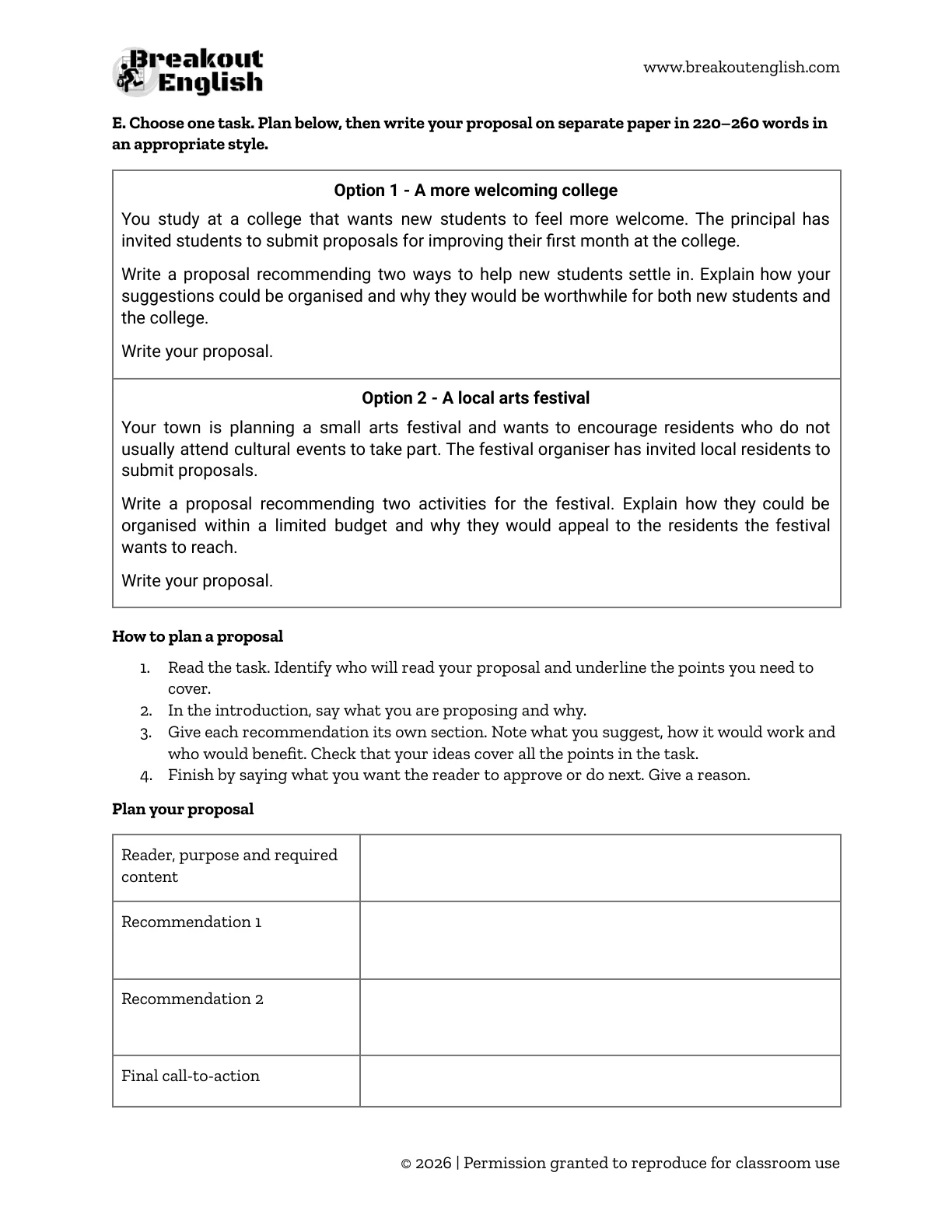
Start your plan by identifying the reader and underlining essential parts of the task. Then decide on your main suggestions and make a few notes about how you’ll develop them. For a question asking for two recommendations, this is a useful structure:
| Section | What to include | Library example |
|---|---|---|
| Introduction | Explain the purpose of the proposal briefly. | Recommend ways to turn the unused area into a shared learning area. |
| Recommendation 1 | Introduce the idea and explain the arrangements and benefits. | Bookable rooms for group work, with one room available at lunchtime without a booking. |
| Recommendation 2 | Develop the second idea, covering the relevant task points. | A flexible studio for revision and digital skills sessions, with a staff coordinator and older students helping to lead sessions. |
| Final call to action | Explain what you want the reader to approve or do next, and why. | Run a short trial to find out which ideas are worth investing in. |
Give your proposal a descriptive title and use headings to help the reader follow it. Bookable project rooms, for example, is more informative than Recommendation 1.
Most of the writing should go into the recommendations. Introduce an idea, then develop it with details that answer the question. In the library proposal, the school’s online booking system explains how the rooms could be managed, while sound-absorbing panels address the effect on other users. Both details help justify the recommendation. A list of furniture with no explanation would be much less useful.
The model below has four paragraphs: an introduction, one paragraph for each suggested facility and a final recommendation. Each of the two central paragraphs explains both the arrangements and the benefits, keeping the details of each idea together.
In the final paragraph, make it clear what action you’re recommending. Here, the question asks for a pilot, so the writer proposes a trial before the library commits to permanent changes. In another task, you might ask for approval of the whole plan or identify the improvement that should take priority. Adapt the ending to the question rather than memorising a conclusion that could go on any proposal.
A C1 Advanced proposal example
The following practice task brings these ideas together. As well as recommending two facilities, you’ll need to explain how they would be organised, who would benefit and how the school could test the ideas. Those points all need space in your plan.
The task

Model answer

Look at what the writer asks the headteacher to approve. The school can try both facilities for six weeks with furniture it already has. The language supports the plan too. Would enable explains a benefit, provided that sets a condition for the workshops and therefore connects the recommendation to the case made for the two facilities.
The materials
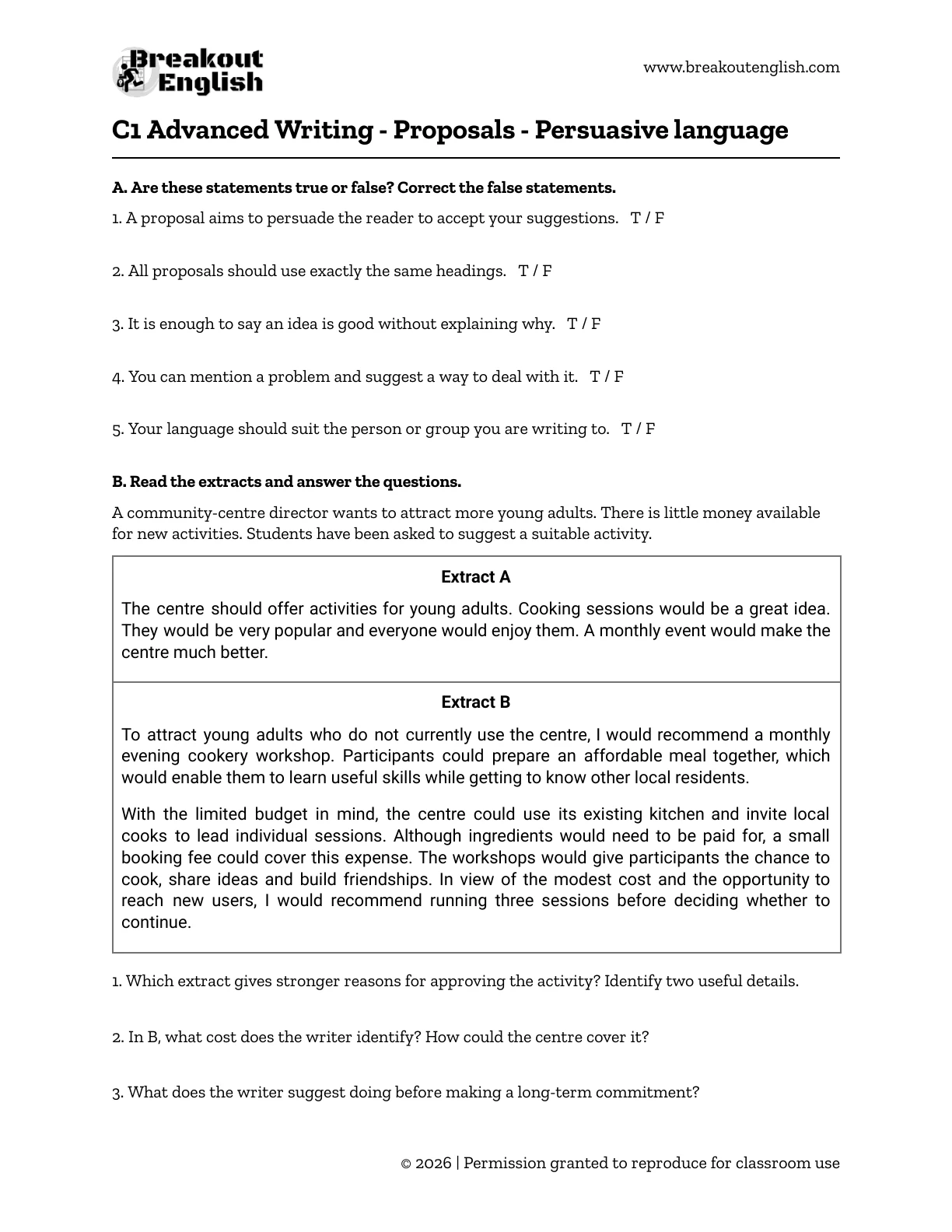
The worksheet focuses on the persuasive language you need for proposals. Compare suggestions, practise useful expressions and improve sentences before using the planning guide to prepare your own writing. There are two tasks to choose from, about a college and an arts festival, so you can try applying the language to a different situation from the library example above.
EXAM PART: C1 Advanced Writing Part 2
EXAM SKILLS: Organising proposals, justifying recommendations and persuading
LEVEL: C1
TOPIC: Persuasive language, college life and community activities
TIME: 45–60 minutes
PREPARATION: One worksheet per student and separate paper for the proposal
Download

Preview