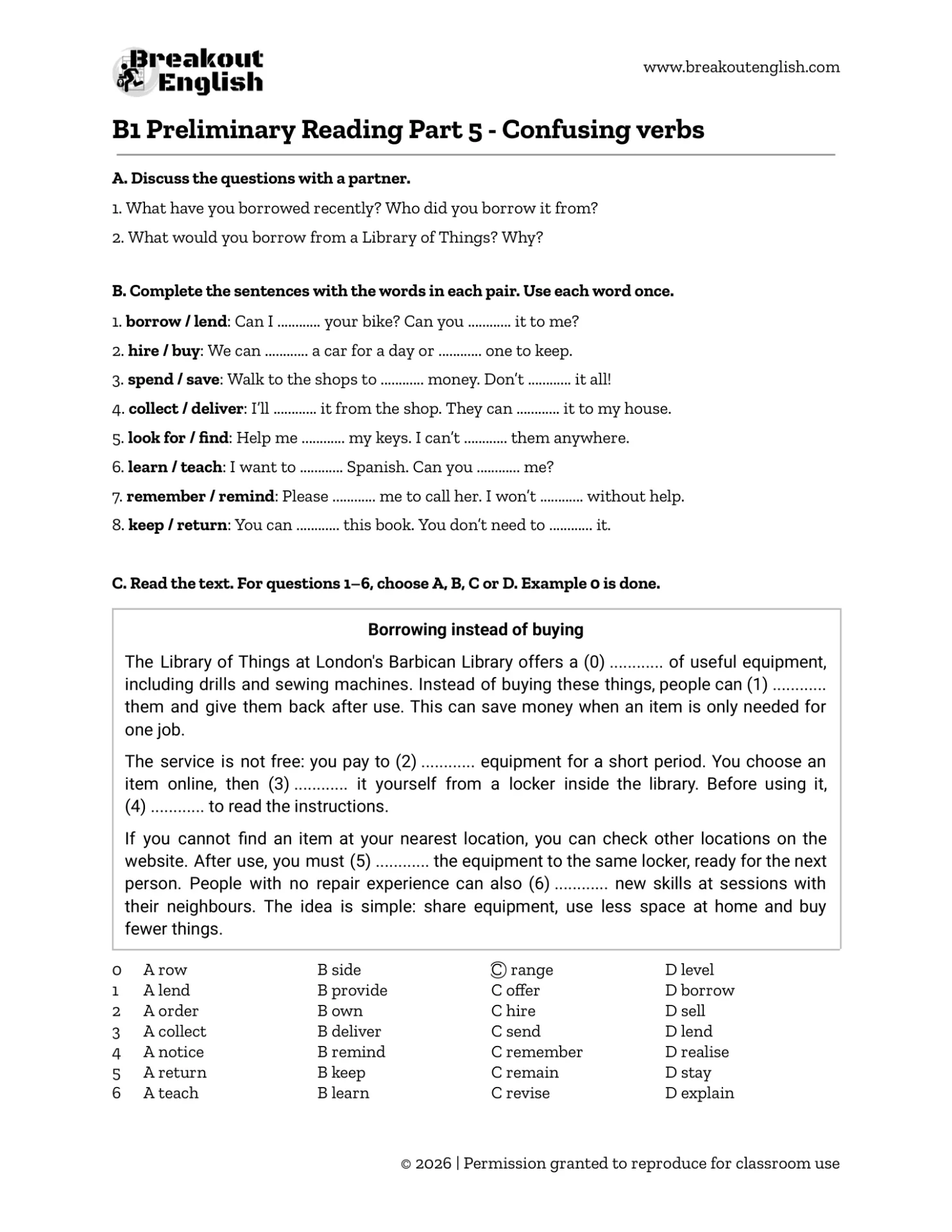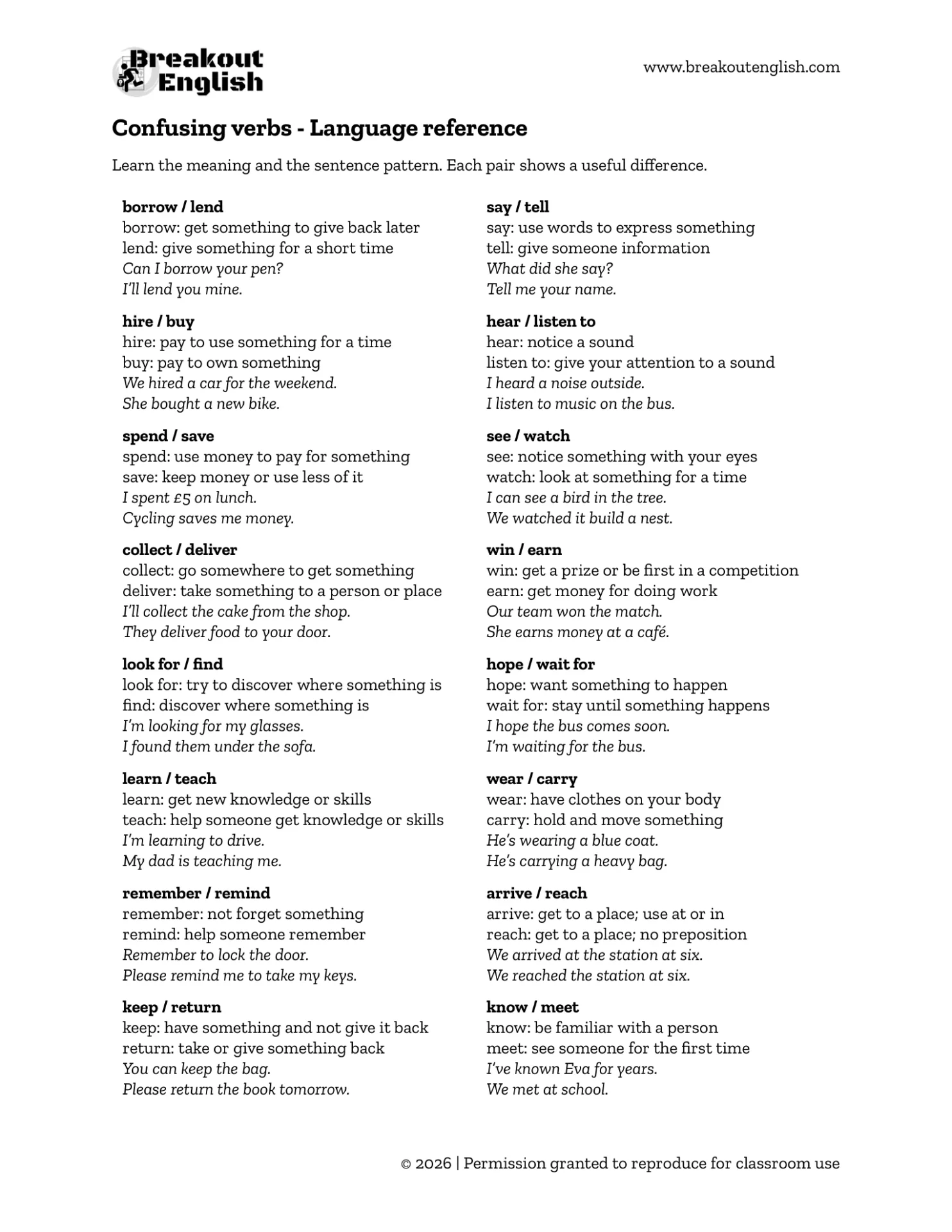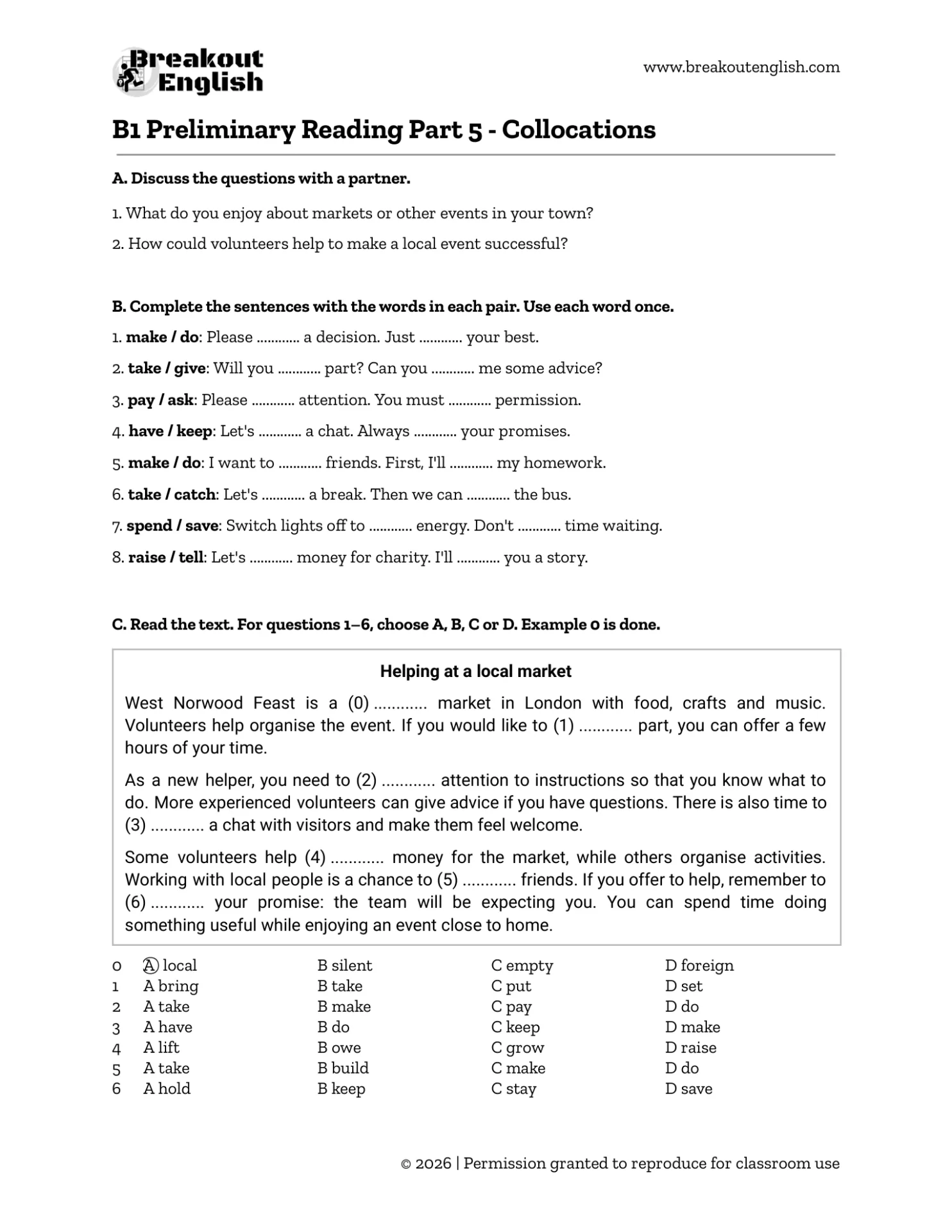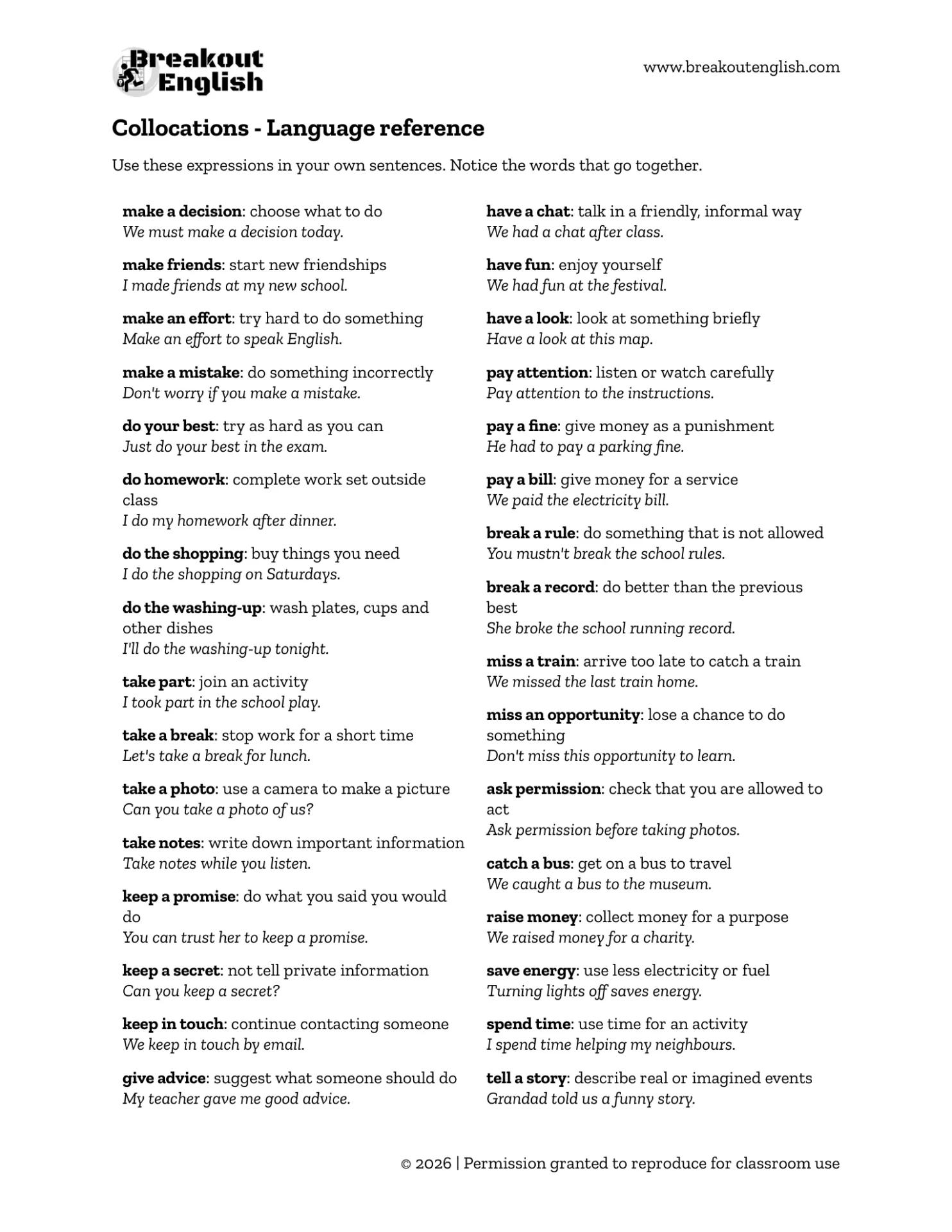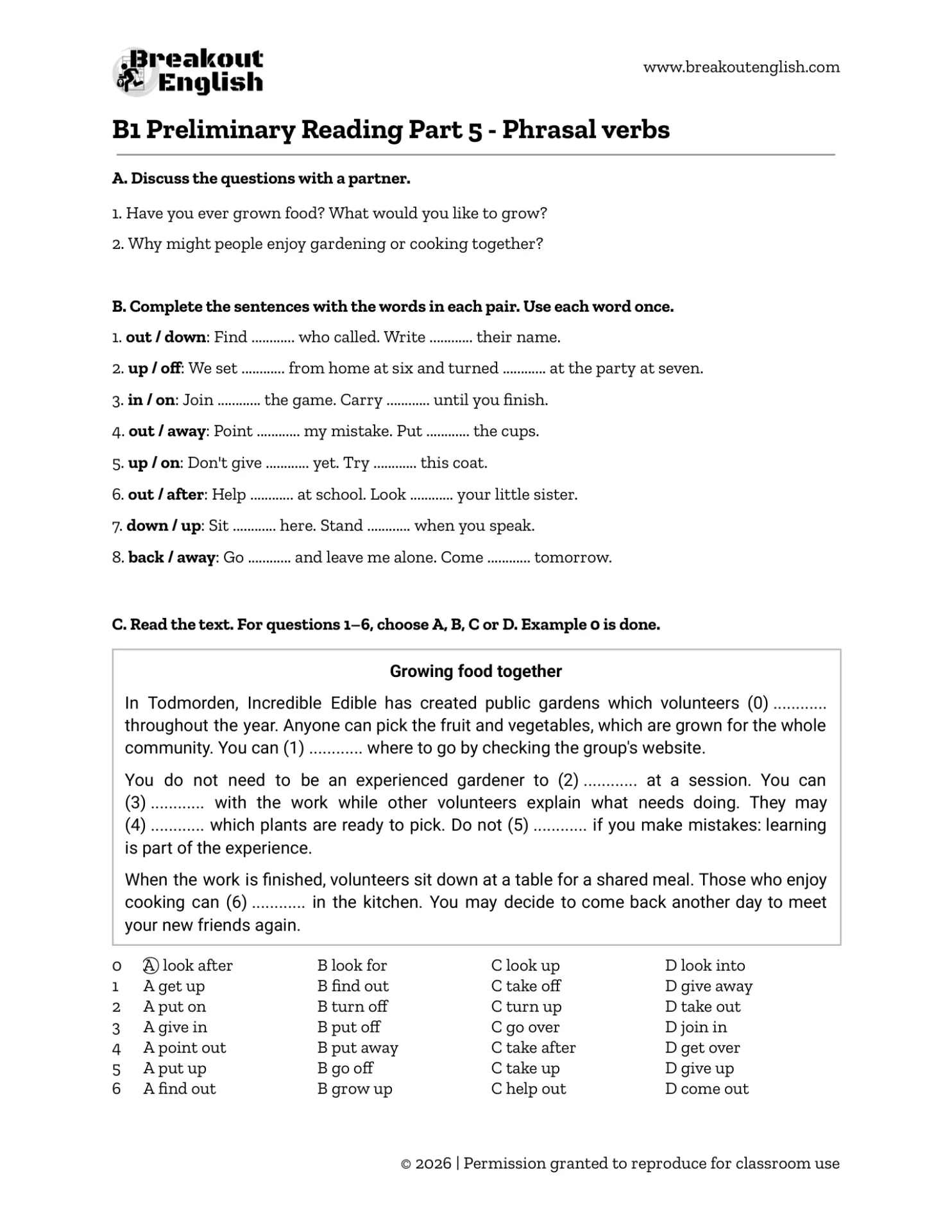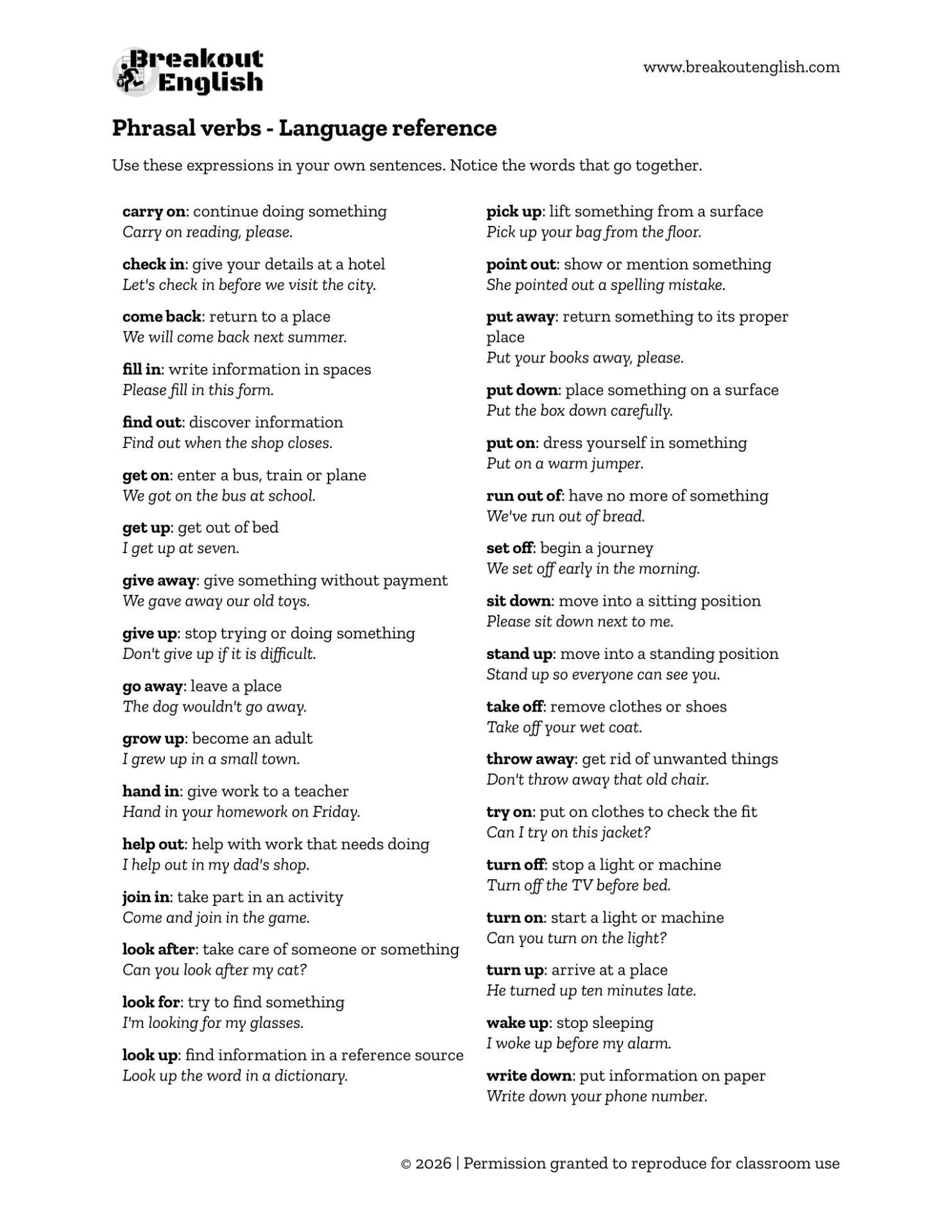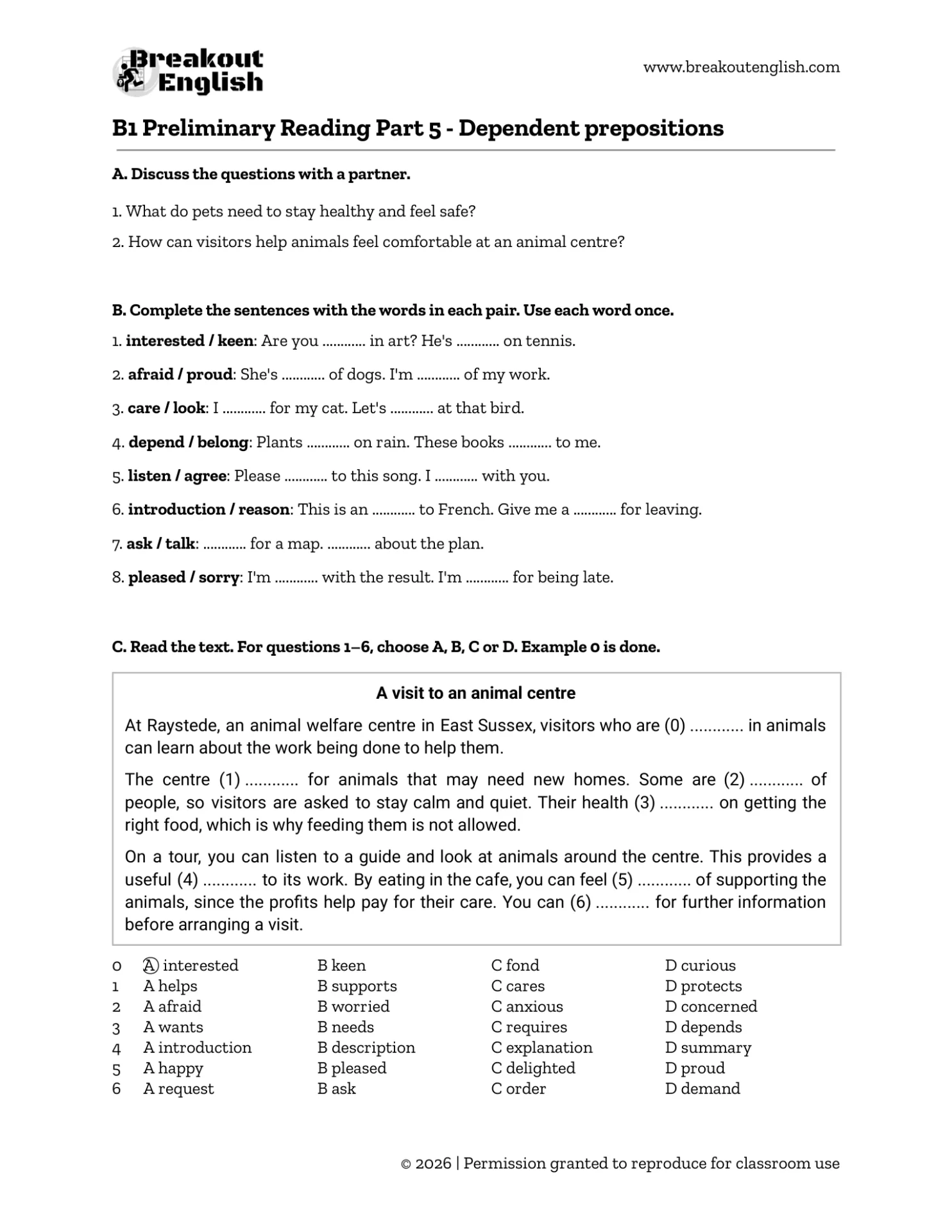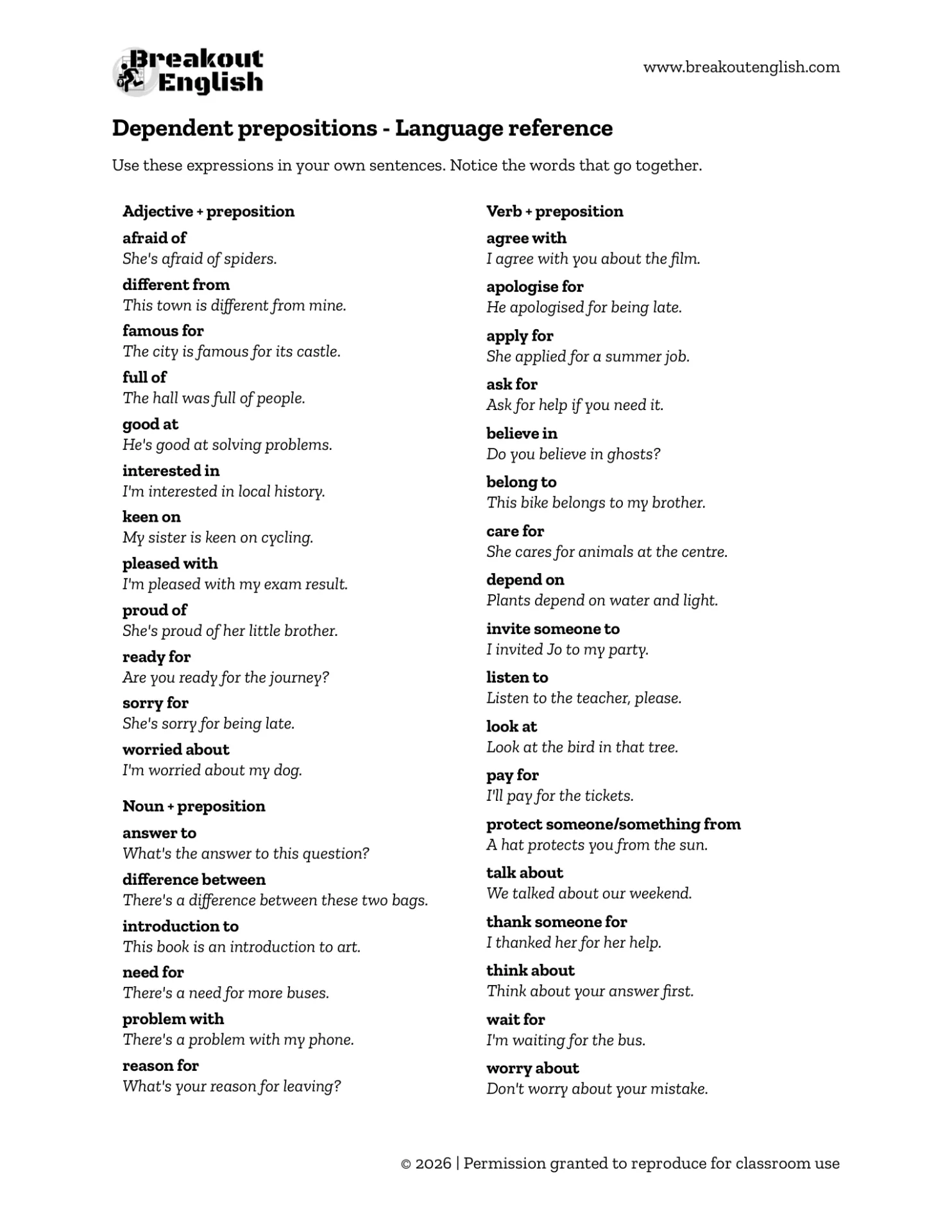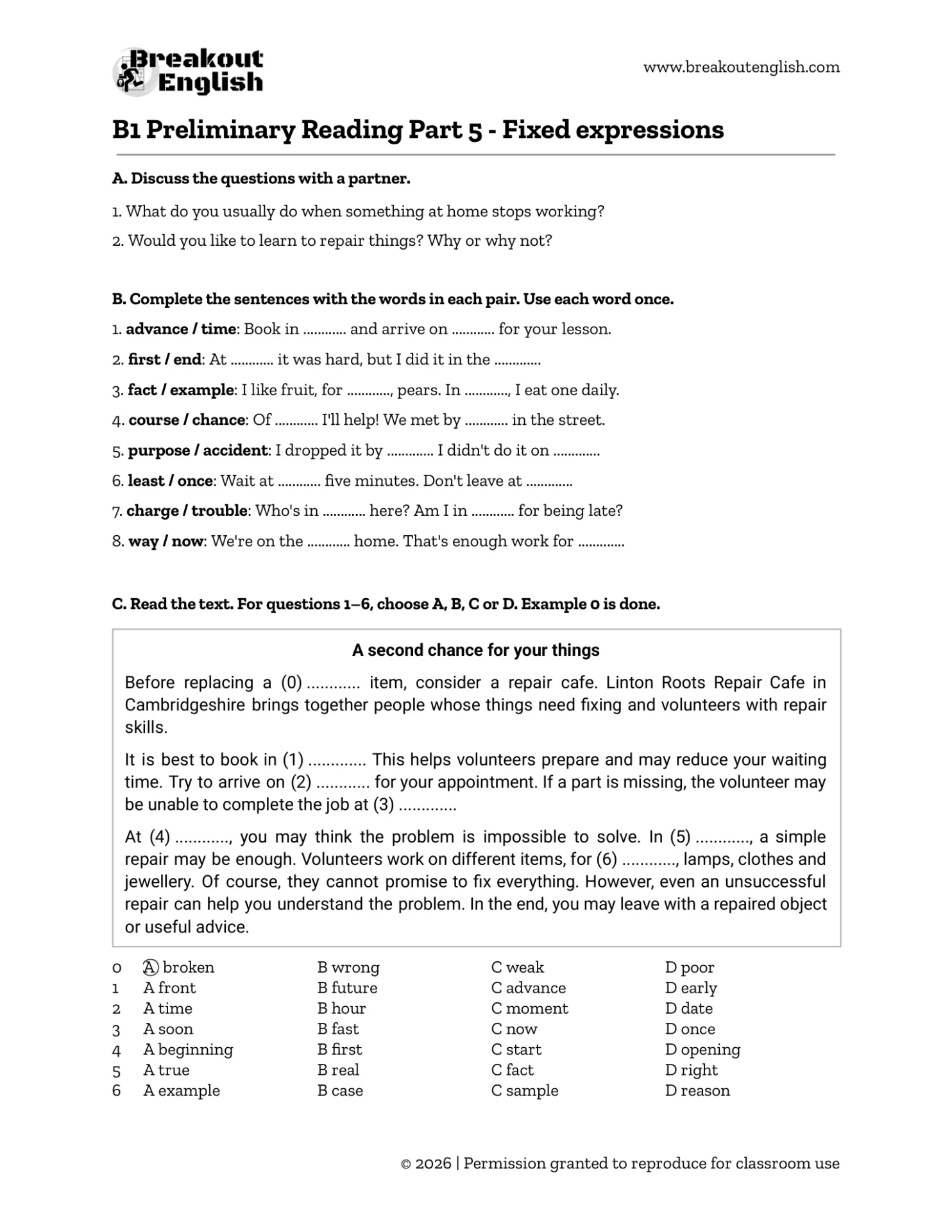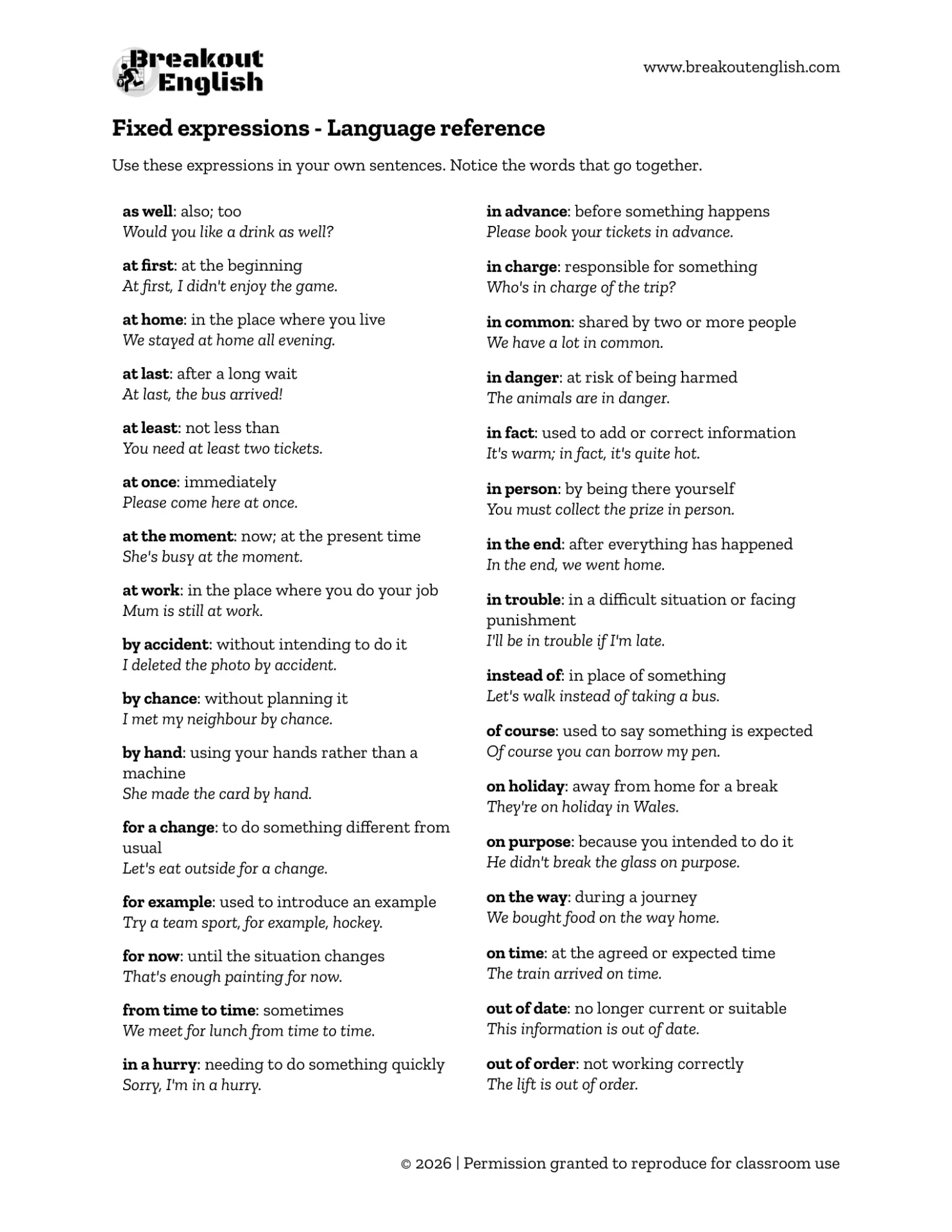
You can know every word in a B1 Preliminary Reading Part 5 question and still choose the wrong answer. The problem is often how those words work together. These five worksheets focus on confusing verbs, collocations, phrasal verbs, dependent prepositions and fixed expressions, giving you time to practise each area before tackling a task that mixes them together.

Contents
What does Reading Part 5 test?
In B1 Preliminary Reading Part 5, you read a short text with six gaps. Each gap has four options. You need to choose the word that fits both the meaning and the language around it. Understanding the four options is only a starting point.
Sometimes two words have similar meanings, but only one goes with the noun or preposition in the text. Sometimes the missing word belongs to a familiar expression. Reading a few words on either side of the gap can make the choice much clearer, although you should always check the whole sentence and text.
Learning words in chunks
A language chunk is a group of words that commonly occur together. Learning these combinations is central to the lexical approach. Instead of remembering only attention, for example, learn pay attention to something. You get the meaning, the verb and the preposition together.
Knowing how words work together is at least as important as knowing what they mean individually. For a particular Part 5 question, it can be the deciding factor. Recognising all four words won’t help much if you don’t know which one belongs in the phrase.
The five areas below give us useful ways to organise that practice. They overlap: a fixed expression can also be a collocation, and a confusing verb may be difficult because of the pattern that follows it. The labels help you notice the language; they aren’t rules for sorting every question into one box.
Confusing verbs
Some verbs describe related actions but show a different direction, role or intention. Others are often confused because learners use the same word for both in their first language.
- Borrow / lend: Can I borrow your bike? Can you lend it to me?
- Learn / teach: I’m learning Spanish. My neighbour teaches me.
- Remember / remind: Remind me to call Sam. I might not remember.
Collocations
Collocations are words that commonly go together. Another word may have a similar meaning, but it doesn’t necessarily make a natural combination. Learn the partnership rather than each word separately.
- Make a decision: We need to make a decision today.
- Do your best: It’s difficult, but do your best.
- Catch the bus: Leave now and you’ll catch the bus.
For more practice with two particularly useful verbs, try our make and do exercises and collocations list.
Phrasal verbs
A phrasal verb combines a verb with a particle such as up, out or back. That little word can change the meaning completely, so knowing the main verb isn’t always enough.
- Find out: discover information. Find out when the centre opens.
- Give up: stop trying. Don’t give up if it’s difficult.
- Look after: take care of someone or something. I look after my sister’s cat.
Record the meaning you meet in context. A phrasal verb can have more than one meaning, so one meaning won’t necessarily cover every use.
Dependent prepositions
Certain adjectives, nouns and verbs are regularly followed by specific prepositions. The word and its preposition need to be learnt together. These patterns are useful to organise into three groups:
- Adjective + preposition: e.g. keen on. We’re keen on gardening.
- Noun + preposition: e.g. reason for. What’s the reason for the delay?
- Verb + preposition: e.g. belong to. These tools belong to the club.
In Preliminary Reading Part 5, the preposition often stays in the text and you choose the word before it. Several options may have synonymous meaning, but only one fits that particular preposition pattern. Look forwards as well as backwards.
Fixed expressions
Fixed expressions are familiar combinations whose wording is largely set. You may understand the individual words, but you also need to recognise the complete expression and the situation in which it is used. When part of an expression is missing, the words left in the text give you a useful clue. Check that the completed expression makes sense in the wider context too.
- In advance: before something happens. Please book in advance.
- By accident: without intending to. I deleted the photo by accident.
- Out of order: not working. The ticket machine is out of order.
The materials
Each worksheet gives you one main language focus. That makes it easier to notice a pattern and practise it several times. You can work on the area that causes the most problems, rather than completing all five in one sitting.
Afterwards, move to a full Preliminary Reading Part 5 task with a mixture of language points. Read the text and answer the questions first. Then go back and look at how you reached each answer:
- Underline the evidence around the gap. Which noun, preposition or part of an expression helped you choose?
- Identify the language focus. Is it a collocation, a phrasal verb, a fixed expression or a difference in meaning? More than one description may fit.
- Explain one rejected option. Would it need a different preposition, a different partner word or a different situation?
- Record the complete phrase. Add a short example of your own, then cover part of it and test yourself again a few days later.
In class, ask students to compare their evidence before checking the key. This gives you more to work with than a string of letters. A correct answer with an uncertain explanation can show you a phrase that still needs practice.
Choose a worksheet and start with the discussion and preparation activity, which introduces 16 language items. Then try the focused multiple-choice cloze before using the expanded reference list to check and extend your notes.
EXAM PART: B1 Preliminary Reading Part 5
EXAM SKILLS: Choosing vocabulary in context and recognising how words combine
LEVEL: B1
TOPIC: Everyday life and community activities in the UK
TIME: 30-45 minutes per worksheet
PREPARATION: One copy of the chosen worksheet per student
Download

Preview