I’ve seen students preparing for B2 First and C1 Advanced still writing wich instead of which, or making spelling mistakes with words such as necessary and successful. It’s particularly noticeable with younger learners: their English has moved on, but some familiar words are still causing trouble. These common spelling mistakes are worth revisiting, especially when a missing letter can cost you a mark in a Cambridge exam.

Contents
When spelling costs you a Cambridge mark
In B2 First and C1 Advanced, correct spelling matters in Reading and Use of English. Knowing which word you need is only part of the job. You also need to write it accurately.
- Word formation, Part 3: each answer is worth one mark. If the spelling is wrong, you don’t get that mark, even if you’ve chosen the right word family and part of speech.
- Key word transformations, Part 4: each answer has two marking sections, worth one mark each. A spelling mistake can cost you the mark for the affected section. Getting the grammar right doesn’t make the spelling error disappear.
Cambridge confirms the spelling requirement in its B2 First candidate FAQs and C1 Advanced candidate FAQs. In Writing, spelling is considered in the broader assessment of your language and communication; it isn’t a simple one-mark deduction for every misspelt word.
Common words that still cause problems
It’s tempting to assume that spelling practice belongs in lower-level classes. Yet a learner can be working on advanced vocabulary while still writing definately or accomodation. Recognising a word when you read it and producing it accurately from memory are different demands.
Start with useful words you actually write. Look at the troublesome part rather than repeatedly copying a whole word without noticing what went wrong.
| Common mistake | Correct spelling | What to notice |
|---|---|---|
| wich | which | Remember the h after w. |
| accomodation | accommodation | Two cs and two ms. |
| neccessary | necessary | One c and two ss. |
| definately | definitely | Keep the spelling of definite. |
| dissapointed | disappointed | One s and two ps. |
| succesful | successful | Two cs and two ss in success; one l in -ful. |
| recieve | receive | The order here is ei. |
| untill | until | One final l. |
Word formation changes the spelling too
Word formation deserves particular attention because spelling changes are part of the challenge. You may need to add a prefix or suffix, change letters inside the word, or make more than one change. Choosing the correct ending and attaching it to the unchanged base word won’t always work.
| Base word | New form | Spelling change |
|---|---|---|
| happy | happiness | Change y to i before -ness. |
| beauty | beautiful | Change y to i; use one l in -ful. |
| true | truly | Drop the final e. |
| necessary | necessarily | Change the final y to i before -ly. |
| occur | occurrence | Double the final r and use -ence. |
These changes need deliberate practice. When you record a word family, write the complete forms: success, successful, successfully. Then cover the list and reproduce it. Being able to say the words is useful, but the exam also requires you to spell them.
For practice using the forms in context, try our word formation exercises and conversation questions. If transformations are your main concern, our C1 Advanced key word transformations guide explains how to approach the task.
Check spelling with a clear purpose
“Check your answers” is easy advice to give. Make it specific enough to be useful. Once you’ve checked meaning and grammar, give spelling its own pass.
- Check the word you have actually written. Look for missing letters, double consonants and endings. Don’t mentally replace your answer with the word you intended.
- Check related forms separately. Knowing success doesn’t guarantee that you’ve written successful or successfully correctly.
- Keep a personal error list. Use mistakes from your own exercises and writing. Cover the correct forms, write them from memory and check them again a few days later.
- Put the corrected words to use. Write a new sentence or short paragraph, then check whether the spelling has stuck.
Word choice matters too. Your and you’re, its and it’s, and advice and advise are all correctly spelt words. You need the one that fits the meaning and grammar of your sentence. A spelling checker may not rescue you.
The materials
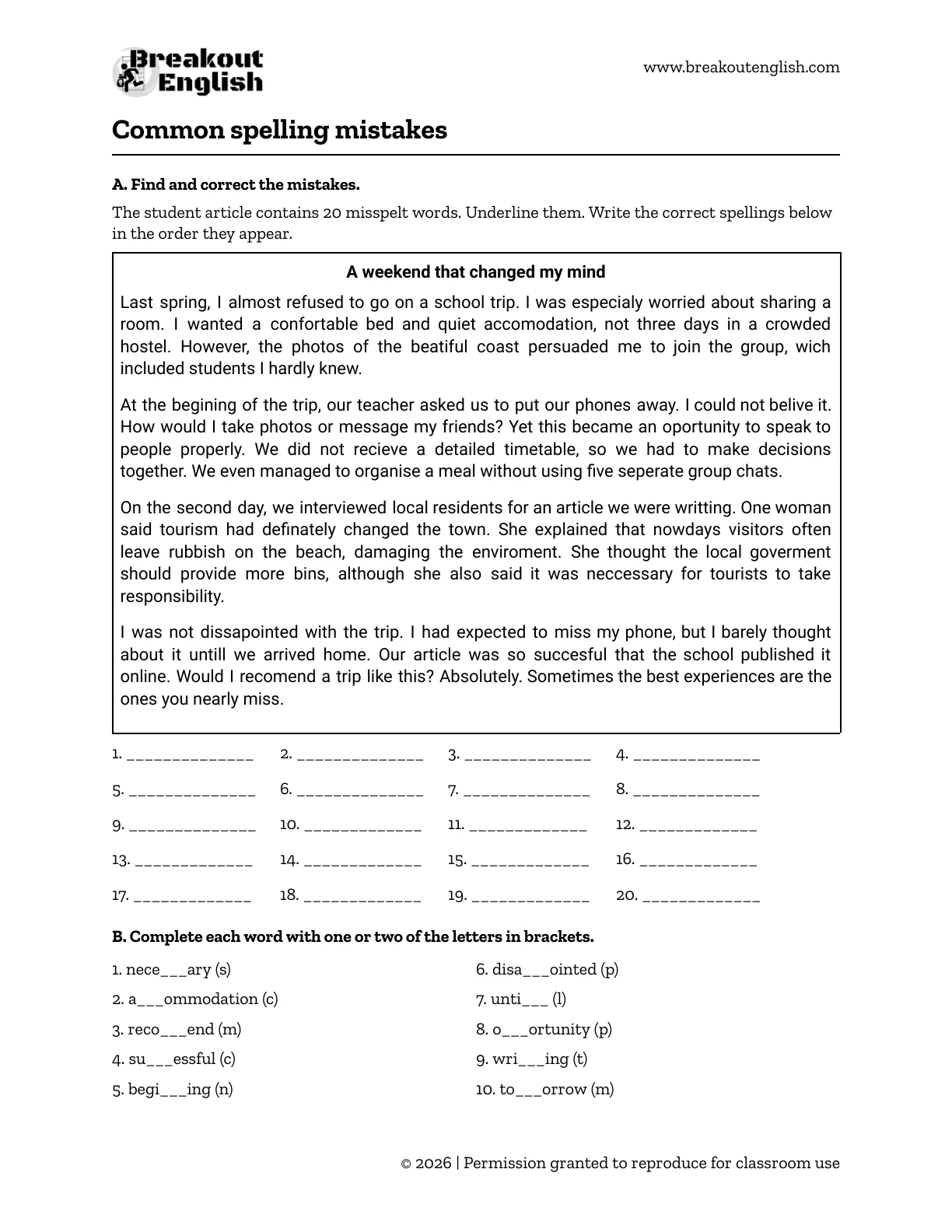
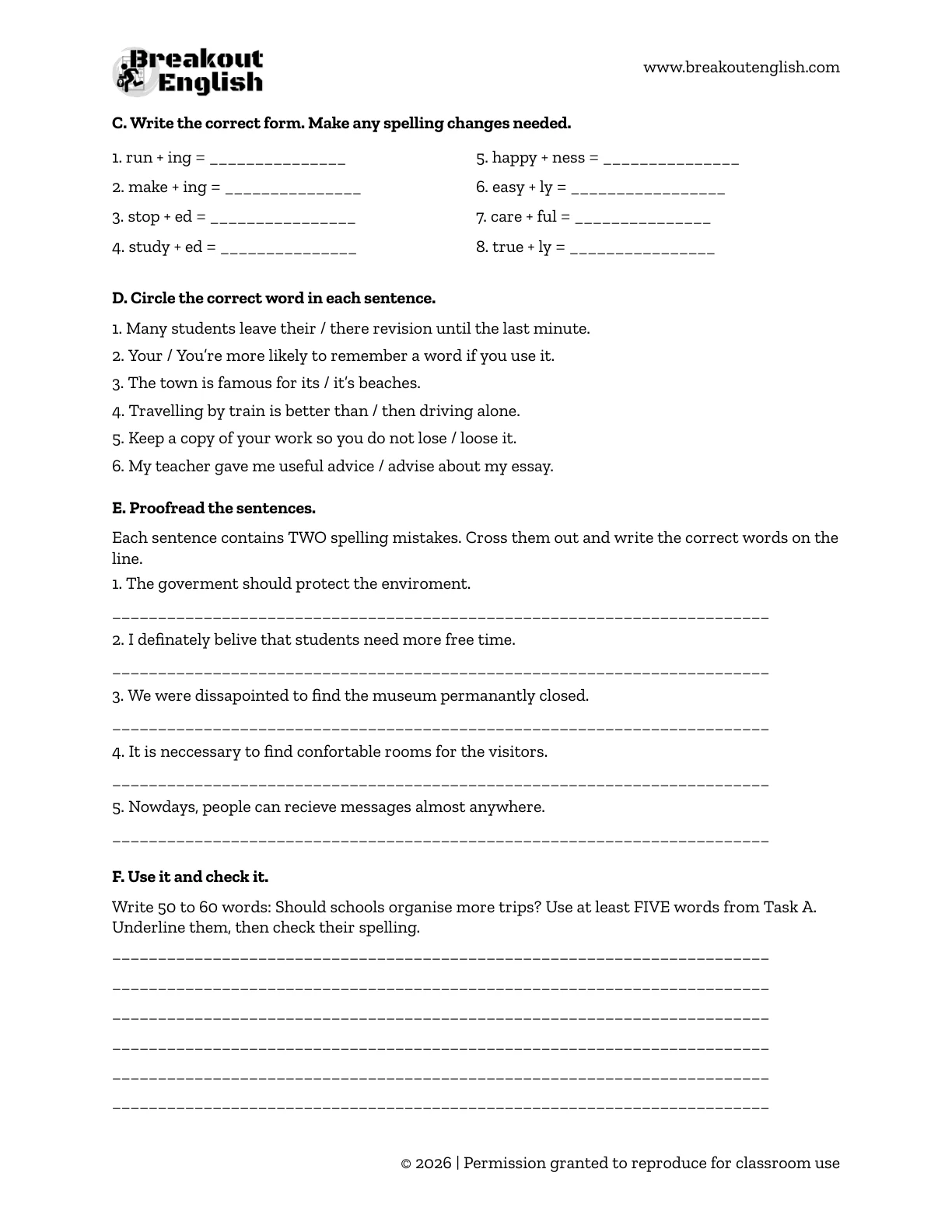
The worksheet starts with a short article containing spelling mistakes, followed by double letters, word endings, easily confused words and sentence proofreading. It finishes with a short writing task that reuses the target words. In class, give students the reading before showing the spelling examples above, let them compare corrections, then check the words they use in their own paragraph.
SKILLS: Writing accuracy, vocabulary and word formation
LEVEL: B1–B2; also useful for spelling revision in B2 First and C1 Advanced classes
TOPIC: Common spelling mistakes
TIME: 30–40 minutes
PREPARATION: One copy of the student worksheet per learner. Keep the final answer page for checking.
Download

Preview