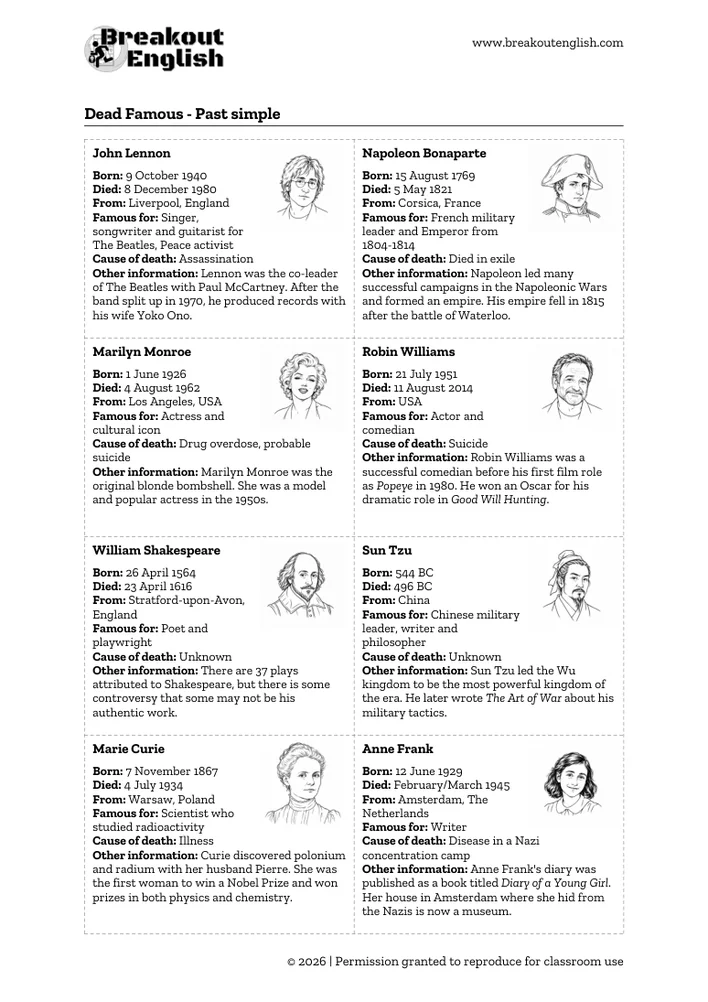
Dead Famous is a past simple speaking game in which students ask questions to identify a famous person. The free printable PDF contains 16 biography cards across two pages, with portraits and clues about each person’s life. It gives learners a reason to practise Did…?, Was…? and short answers while trying to solve a mystery. The game works well as a B1 grammar revision activity. You can also use a smaller selection of familiar people with A2 learners who have already studied the past simple. Play as a class, in teams or in small groups.

Contents
Past simple grammar for the game
We use the past simple to talk about completed events and situations in the past, including someone’s life and achievements. A finished time may be stated, such as in 1934, or understood from the context. This is useful for biographies, but it does not mean that every sentence about a person who has died must use the past simple: “Shakespeare’s plays are still popular” describes something that is true now.
- Positive: subject + past form. “John Lennon played the guitar.” “He wrote songs.”
- Negative: subject + didn’t + base form. “He didn’t work as a scientist.”
- Question: Did + subject + base form? “Did he sing in a band?”
- Short answers: “Yes, he did.” / “No, he didn’t.”
The verb be works differently. Use was or were, without did: “Was he British?” “Yes, he was.” / “No, he wasn’t.” With a plural subject, use were: “Were they musicians?”
Useful past simple questions
Start with broad questions, then narrow down the possibilities. Keep the person’s name secret and use he, she or singular they consistently. These examples use she:
- Was she a scientist?
- Was she from Europe?
- Was she born before 1900?
- Did she live in the USA?
- Did she write books?
- Did she win a Nobel Prize?
For this guessing game, use questions that can be answered with yes or no. Questions such as “Where did she live?” are grammatically correct, but they reveal too much information for the main round. Save them for a follow-up discussion.
Mistakes to listen for
- “Did she wrote books?” → “Did she write books?” After did, use the base form.
- “She didn’t lived in England.” → “She didn’t live in England.” The same rule applies after didn’t.
- “Did he was a singer?” → “Was he a singer?” Make questions with be by changing the word order.
- “Yes, she was” in reply to “Did she write books?” → “Yes, she did.” Match the short answer to the verb in the question.
For further grammar practice, see the British Council’s past simple explanation.
How to play Dead Famous
- Prepare the cards. Print the two pages single-sided and cut along the card borders. Choose people your class is likely to recognise.
- Model a round. Pick a card, keep it hidden and invite questions. Put a few examples with Did…? and Was…? on the board.
- Answer from the clues. Use short answers. If a question cannot be answered from the card and you are unsure of the fact, say “I don’t know” and let the students ask another question.
- Let students guess. After asking questions, a student or team can suggest a name. A correct guess wins the card and one point.
- Change roles. The next student takes a new card and answers the questions. Continue until the agreed time is up, then count the points.
In small groups, give each group a set of cards and take turns as the person answering. For a more challenging version, allow up to ten yes/no questions and one final guess per card.
Adaptations and follow-up activities
If students do not know the people: show the names and portraits before playing. Alternatively, display a shortlist of possible names during the game. The aim is to practise questions, so students need a fair chance of recognising the answer.
For online classes: privately send one card to the student answering. The rest of the group asks questions aloud. Share the card with everyone after the person has been identified.
After the game: ask pairs to write a short biography using one card, or change their yes/no questions into questions with when, where and what. Keep notes during play and finish with a few successful sentences and anonymous corrections.
The materials
The downloadable past simple game contains 16 cards about writers, musicians, scientists, leaders and other well-known figures, including Marie Curie, John Lennon and Amelia Earhart. The portraits help students recognise the people, while the biographical clues support the student answering questions.
Earhart’s card labels 2 July 1937 as the date she disappeared, rather than a confirmed date of death. Follow the wording on the card when discussing this clue.
For another activity comparing past tenses, try Liar, liar! – a present perfect and past simple game.
LEVEL: B1; adaptable for A2 learners with support.
SKILLS: Speaking, listening, past simple questions and short answers.
TIME: 30–45 minutes, depending on the class and number of rounds.
PREPARATION: Print single-sided on card and cut up. For online play, prepare individual card images to share privately.
Download

Preview