
By B2, learners taking an exam should be comfortable using conditionals, which is why we’ve designed 10 B2 First conditionals transformations. The key-word transformations activity, Use of English Part 4, is one of the likely areas where you may encounter conditionals (they could also pop up in Use of English Part 2, the open cloze).

Contents
Types of conditionals
The important thing at this level is perfecting conditionals. You shouldn’t be stumbling around them or having to think carefully about the grammar. It should come naturally. What that requires is practice. Conditionals are formulaic to an extent, but also have certain flexibility which can be glossed over in grammar rules.
Here are five common conditional patterns to practise at B2. At more advanced levels, we can start to pick these conditionals apart, but for B2, make sure that you’ve got the basics covered.
Zero conditional – If I see someone eating, I get hungry – These conditionals describe situations that are always true. We use present tenses in both the conditional clause and the consequence.
1st conditional – If I pass my exam, I will celebrate – This describes a possible future situation and its result. A common pattern is present simple in the if-clause and will + infinitive in the result clause. Related conjunctions such as unless, when and as soon as express different meanings, so they cannot always replace if.
2nd conditional – If I had enough money, I would buy a house – Now we are discussing hypothetical situations. The conditional clause is an unreal situation with a corresponding unreal consequence. These can be either unrealistic situations or impossible ones. We use past tenses in the conditional clause and modal verbs for the consequence. B2 level is a good time to introduce 2nd conditionals with provided/as long as.
3rd conditional – If I had gone to university, I would have been more successful – This is where we start discussing the past. An unreal past condition with an unreal past consequence. A common form is if + past perfect, followed by would/could/might have + past participle.
Mixed conditionals – If I had made a sandwich, I wouldn’t be hungry at the moment – Mixed conditionals are a combination of the 2nd and 3rd. It’s an unreal past condition with an unreal present consequence. While they may appear confusing at first, mixed conditionals are actually quite common because we constantly lament our past and how it affects our present. In this past-to-present pattern, use past perfect in the if-clause and would + infinitive for the present result. Note that mixed conditionals can also be flipped and have an unreal present situation with an unreal past consequence.
Learn about conditionals in even more detail with our post on real and unreal conditional sentences.
The materials
After you’ve covered the grammar and done a nice fun communicative task using conditionals, your students still need to practise seeing the grammar in an exam format.
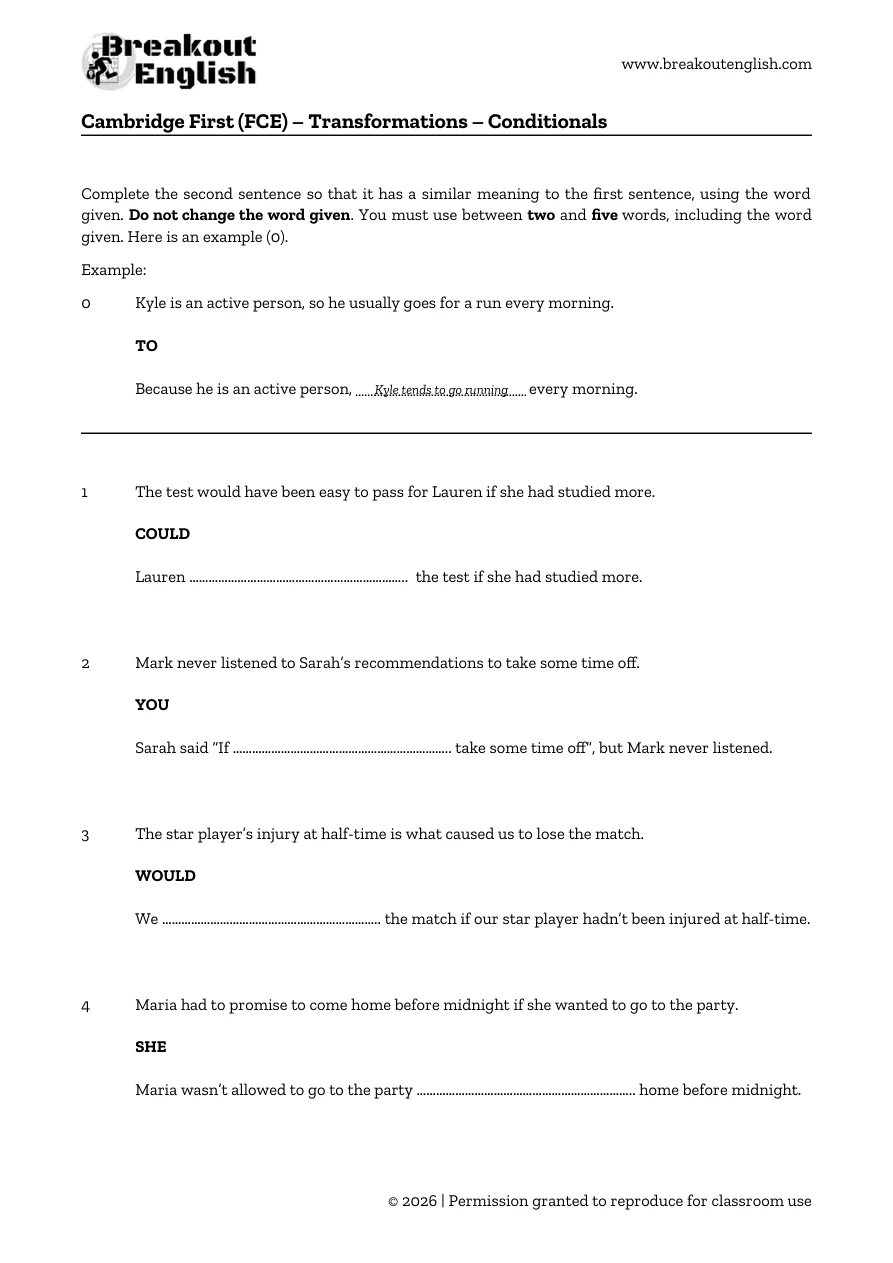
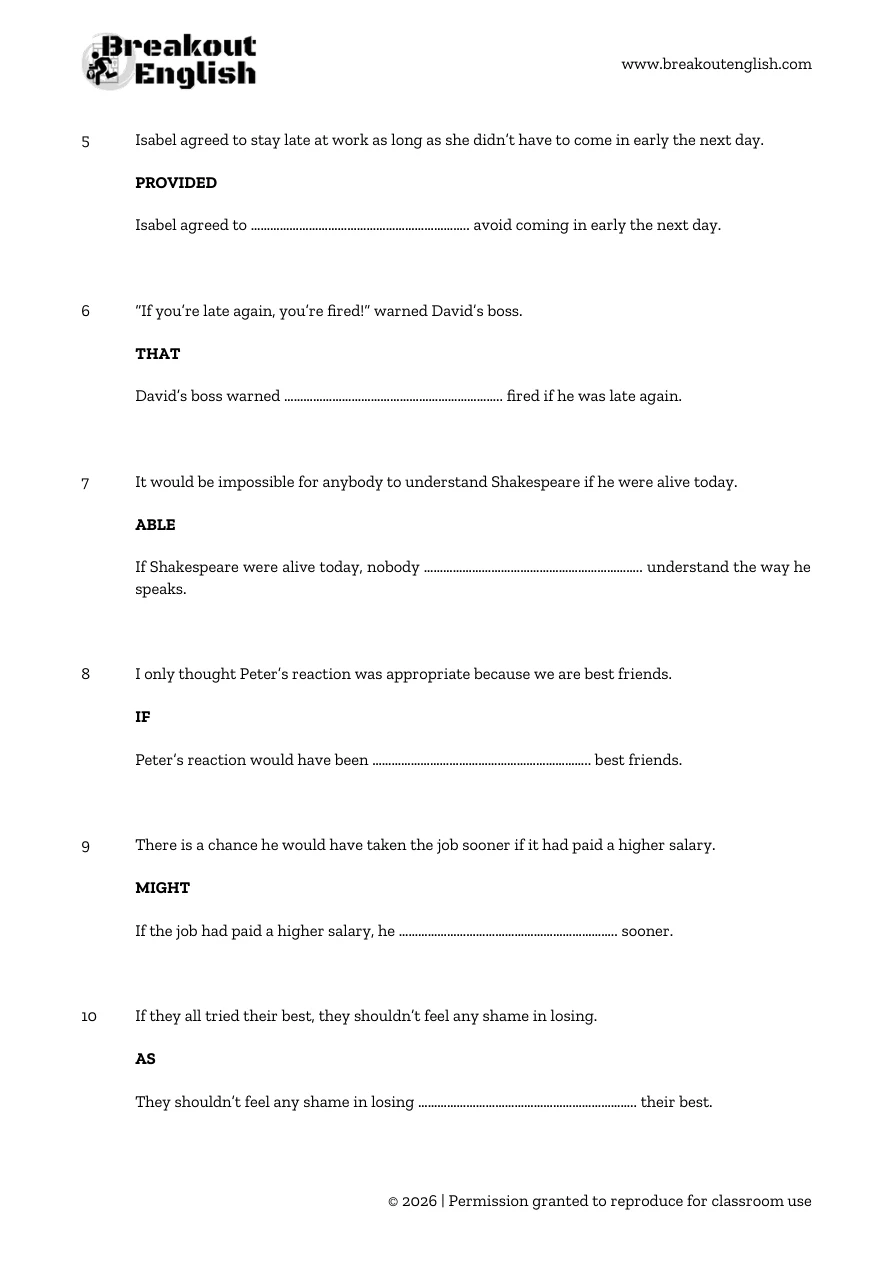
Here, we have 10 transformations using conditionals. They have been designed to be challenging. I often find transformations with conditionals in course books are too easy, but these will force your students to push the limits of their grammar knowledge.
EXAM PART: B2 First Reading and Use of English Part 4
EXAM SKILLS: Using grammar appropriate to the level (B2), transformations
LEVEL: B2
TOPIC: Conditionals
TIME: 20–30 minutes
PREPARATION: One copy of the worksheet per student
Download

Preview

250 Key Word Transformations
Find more conditional transformations alongside reported speech, dependent prepositions and phrasal verbs in 250 Key Word Transformations.
Digital PDF: €8.95 · Also available in paperback

Thank you so much !
Just saved me a lot of time.
Really appreciate you.
Jocelyn
Great! Thank you! Material to practice is always welcome.