Make and do are notoriously difficult for learners of English to distinguish. You do your homework, but you make a mistake. You make dinner, but you do the cooking. Just when you think you’ve found a rule, another expression comes along to spoil it. As a starting point, make often means creating or producing something, while do often refers to an action or task. However, many combinations need to be learnt together. Below, you’ll find an explanation, a list of make and do collocations, and exercises to use in class or study at home.

Contents
What is the difference between make and do?
Make often focuses on something you create or produce. You can make a sandwich, make a plan or make a suggestion. The result doesn’t have to be something you can hold in your hand.
Do often focuses on carrying out an action or task. You can do homework, do the shopping or do exercise. We also use it for general activities when we don’t name a specific action: do something, do nothing and do your best.
These are useful patterns, but they won’t explain every expression. Make the bed, for example, means arranging the sheets and covers. You don’t have to build a new bed every morning.
The safest approach is to learn the verb and the words around it as a unit. This is called a collocation: a combination of words that are commonly used together.
Make and do collocations
We’ve separated these common combinations into categories because who doesn’t love categories? Start with a group you use regularly, rather than trying to memorise the whole list at once.
Collocations with make
Food and drink
- make breakfast / lunch / dinner
- make a cup of tea / coffee
- make a sandwich
- make a salad
- make cookies / cupcakes / brownies
- make dessert
- make a cake
Communication
- make noise
- make a sound
- make a suggestion
- make a complaint
- make an excuse
- make a point
- make a prediction
- make a phone call
- make an observation
- make a mistake / an error
- make a fuss
Plans and decisions
- make plans
- make a decision
- make a choice
- make arrangements
- make an appointment
- make a reservation
- make a promise
Money
- make money
- make a profit
- make a loss
- make a fortune
- make an investment
Other
- make the bed
- make a difference
- make a mess
- make friends
Collocations with do

Housework
- do chores
- do the dishes / washing-up
- do the ironing
- do the shopping
- do the washing / laundry
- do the cooking
Non-specific activities
- do something
- do nothing
- do anything
- do the right thing
- do good
- do well
- do badly
- do your best
Jobs and tasks
- do homework
- do a good job
- do overtime
- do a crossword
- do a course
- do your duty
- do an exam
- do an activity
- do paperwork
- do business
- do research
Sports and activities
- do exercise
- do yoga
- do gymnastics
- do karate
Common mistakes with make and do
The general difference between make and do is a useful starting point, but it doesn’t explain every collocation. Learn these common combinations as complete phrases:
- Make a mistake, not
do a mistake . “I made a mistake when I wrote your address.” - Do homework, not
make homework . “I need to do my homework before we go out.” - Make a decision, not
do a decision . “We haven’t made a decision about our holiday yet.” - Make an effort, not
do an effort . “She’s making an effort to speak English every day.” - Make progress, not
do progress . “Your English is improving. You’re making progress.” - Do research, not
make research . “We did some research before choosing a new phone.” - Make changes, not
do changes . “The teacher made a few changes to the timetable.” - Do exercise, not
make exercise . “I do some exercise before I go to work.”
Learn the noun pattern too. Homework, research and progress are uncountable here: do some homework, do some research and make some progress. Avoid a homework, a research and a progress.
Other verbs to watch out for
Sometimes you need another verb. These expressions are useful to compare:
- Take a photo: “Could you take a photo of us?” Use take when you mean capturing an image with a camera.
- Have a party: “We’re having a party for my sister’s birthday.” You can also throw or organise a party.
- Take, sit or do an exam: “I’m taking my English exam next month.” Sit an exam is also common in British English, and do an exam is a more informal option. We don’t use make an exam to mean taking it as a candidate.
Both verbs are irregular: make, made, made and do, did, done. For example: “I’ve done my homework, but I’ve made a mistake.”
For more examples, see Cambridge Dictionary’s guide to common collocation errors.
Make and do in B1 Preliminary
These collocations are useful for everyday English and for B1 Preliminary preparation. Reading Part 5 tests vocabulary through a multiple-choice gap-fill text. Knowing which words go together can help you choose the correct answer.
In Speaking and Writing, use combinations that fit what you want to say. Make plans, do homework and make friends can all be useful when talking about your life. There’s no need to squeeze them into every answer.
The materials
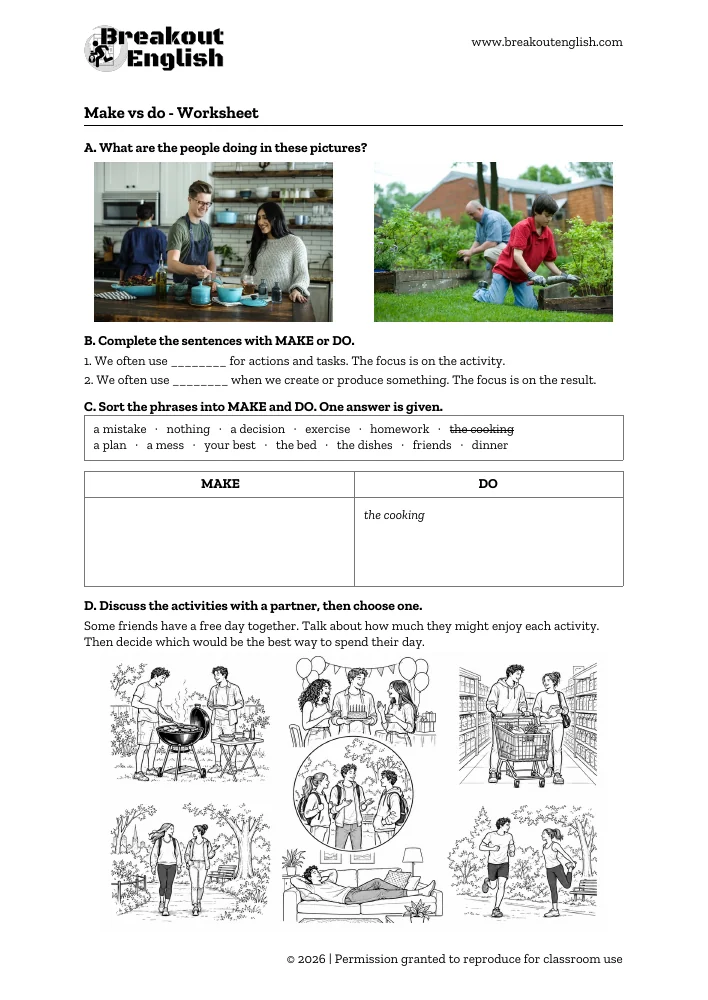
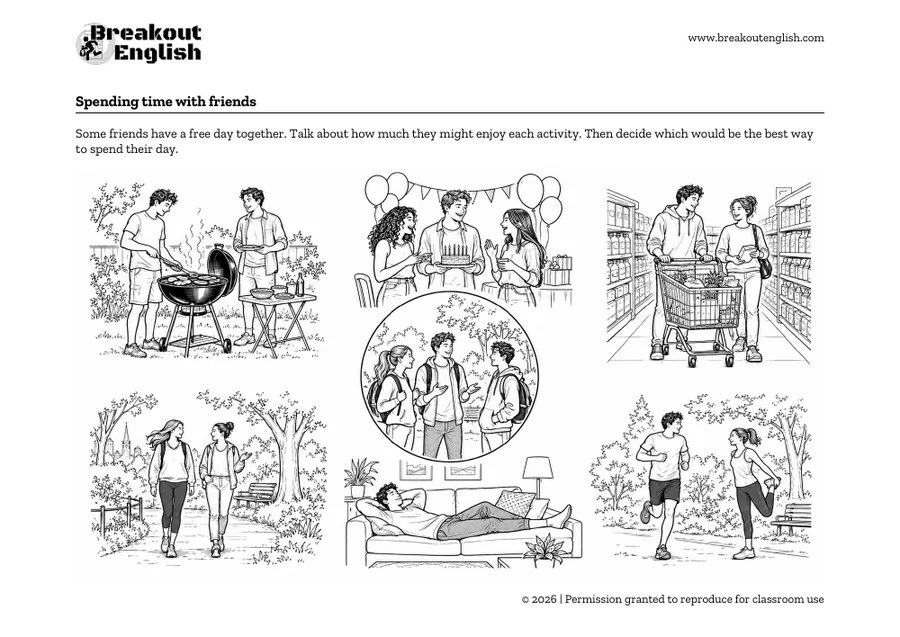
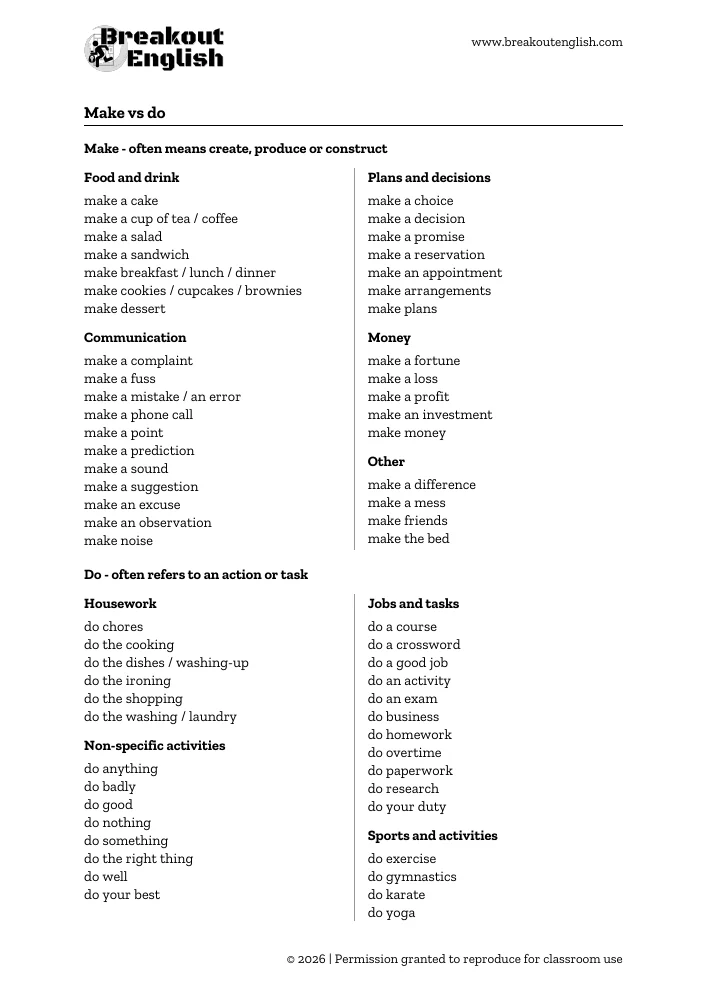
There are three downloads: a make and do worksheet, a separate speaking task and a collocations list. The worksheet introduces the meaning, asks you to sort collocations and finishes with a discussion about spending a day with friends. The separate speaking sheet provides larger pictures for that discussion.
Studying make and do at home
- Try the worksheet before checking the list. Notice which combinations you already know and which you need to learn.
- Choose a small set to practise. Write a sentence about your own life for each one. “I do my homework after dinner” is easier to remember than an isolated word.
- Test yourself. Cover the verb in your notes and try to remember it. Check again a few days later.
- Use the language. Try the speaking task with a partner. If you’re studying alone, record yourself discussing the options. It’s useful speaking practice, although it doesn’t replace practising interaction with another person.
Using make and do in class
Start with the worksheet’s pictures and ask your students what the people are doing. Use their ideas to introduce the difference between the verbs, then let them complete the sorting task. Check the full combinations together before moving on to the speaking activity.
While pairs discuss the options, note down good examples and recurring errors. Give feedback, change partners and repeat the discussion. Don’t turn it into a competition to use the most collocations. They still need something sensible to say.
Return to a few expressions in later lessons. A quick game of Pictionary, charades or Taboo can help, as long as students recall the whole combination, not just the noun.
EXAM PART: B1 Preliminary Reading Part 5; vocabulary practice for Speaking and Writing
EXAM SKILLS: Recognising collocations and using appropriate vocabulary for everyday situations
TIME: Allow 20-30 minutes for the suggested classroom sequence
PREPARATION: One copy of the worksheet per student; the collocations list for reference and the larger speaking sheet if needed
Download

Preview