
In Cambridge B2 First Speaking Part 3, useful phrases can be anything that helps you keep the communication going. This is the collaborative task in the exam, where you have to communicate with your partner about a topic provided by the examiner. The topic includes a question to discuss and several ideas to debate. Having a few useful phrases ready can help you get started, respond to your partner and keep the discussion moving. The important thing is what you do with them. Saying “I completely agree” is a start, but explaining why gives your partner something to respond to.

Contents
What is B2 First Speaking Part 3?
B2 First Speaking Part 3, also known as the collaborative task, involves a discussion divided into two stages. In the first stage, you and your partner have two minutes to discuss the examiner’s question using the written prompts. Give your opinions, explain your reasons and respond to each other’s ideas.
In the second stage, the examiner gives you a decision to make and you have one minute to discuss it together. Listen carefully to this new question so you know what to choose.
There isn’t a single right answer. Try to discuss the different options and negotiate towards a decision, but don’t race through the prompts just to tick every box. If you run out of time before covering every prompt or agreeing on a choice, the important thing is that you’ve discussed the topic together.

Tips for B2 First Speaking Part 3
Have a conversation. Listen to what your partner says, respond to it and add something of your own. “I think exercise is important because it helps students relax after studying” gives you much more to discuss than “Exercise is good”.
Share the speaking time. Invite your partner to contribute, but don’t ask question after question without giving your own opinion. You can also disagree politely. Try “I see your point, but…” and explain why. During the decision stage, compare your choices and look for an option you both support.
B2 First Speaking Part 3 useful phrases
Useful phrases for B2 First Speaking Part 3 aren’t fixed. There are infinite ways to express yourself and interact with your partner. However, sometimes it’s helpful to have a list to study and practise. But be careful! You don’t want to get repetitive with these useful phrases. If you aren’t saying anything interesting yourself, asking your partner what they think all the time won’t help. Likewise, if you use an expression to disagree, make sure you then extend and explain what you disagree with.
You won’t get extra points just for using a memorised expression. You have to use it logically and respond to the discussion you’re actually having.
Getting started
- Which one shall we start with?
- What do you think, [name]?
- [Name], what’s your opinion on [topic]?
Agreeing
- I completely agree.
- I couldn’t agree more.
- You’re right.
- I see your point.
- I know what you mean.
- I agree with you on that.
- Exactly!
- Absolutely!
- Definitely!
- That’s a good point.
Disagreeing politely
- I don’t quite agree with you.
- I see it a little differently.
- I see where you’re coming from, but…
- I think it would be better to…
- I’m afraid I disagree.
- I’m not so sure about that.
- Maybe, but what about…?
- One problem with that idea is…
- Yes, but the thing is…
Moving the discussion on
- Let’s move on to [topic].
- What’s your opinion on [topic]?
- What do you think about [topic]?
- What are your thoughts on this one?
- How do you feel about that option?
Inviting a response
- Do you agree?
- Do you have any other comments?
- Do you have anything to add?
- Does that make sense to you?
- How do you feel about it?
- What are your thoughts?
- What do you think? / Why do you think that?
- What would you suggest?
Reaching a decision
- Are we both in favour of [option]?
- I don’t think [option] would be the best choice.
- I think we can rule out [option]. What do you think?
- OK, so we agree on [option].
- Shall we choose [option] because…?
- So, which option do you think is best?
- We see it differently. Could we consider [option]?
- Would you choose [option]?
Putting the phrases together
Here’s how a few of these phrases could work in a discussion about activities that help students relax:
A: Which one shall we start with? I think exercise is a good option because it gives students a break from studying. What do you think?
B: I agree with you on that. It could also help them sleep better. How do you feel about listening to music? That’s easier to do when you only have a short break.
A: That’s a good point. Music might be more practical during the school day.
If the decision question asks for the most practical activity, you might continue: “Shall we choose listening to music because students can do it almost anywhere?”
The materials
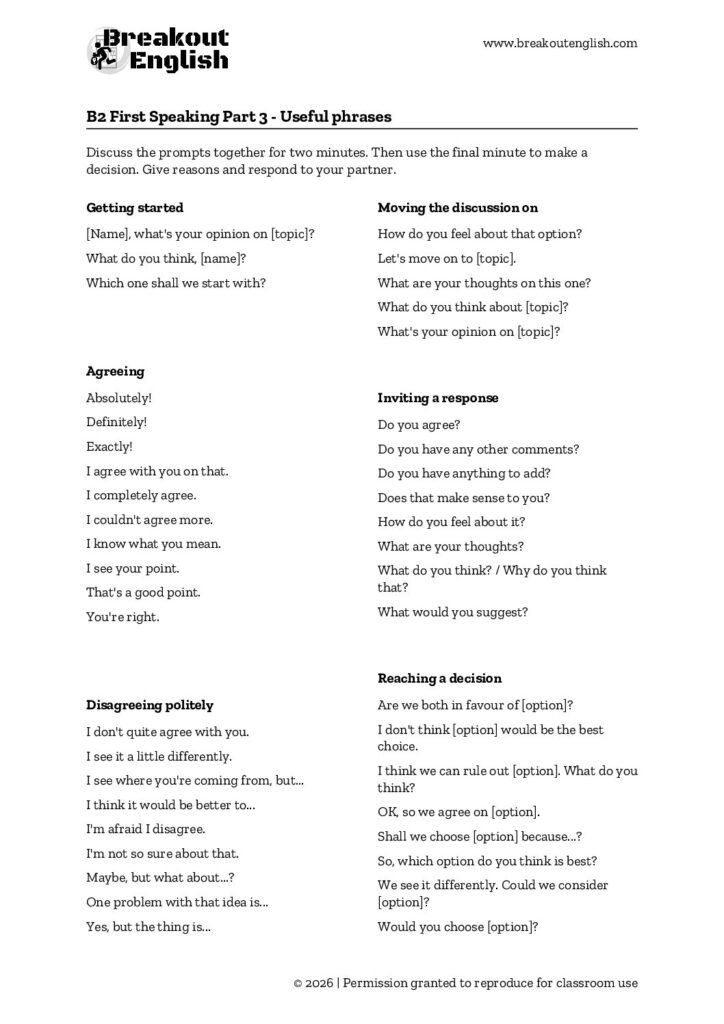
The downloadable phrase sheet organises the language into the same six groups as the list above. Keep it next to you while practising, then turn it over and try again without reading from it.
In class, try groups of three: two candidates and an observer who listens for reasons and responses to a partner’s ideas. After two minutes, give the pair a decision question and one more minute. Then swap roles. The aim is to use the phrases where they fit, not squeeze the whole sheet into one conversation.
Download

Preview

5 Speaking Tests
Try five complete B2 First Speaking tests covering all four parts, with examiner scripts and visual materials for classroom or partner practice.
Digital PDF: €3.95 · Also available in paperback
