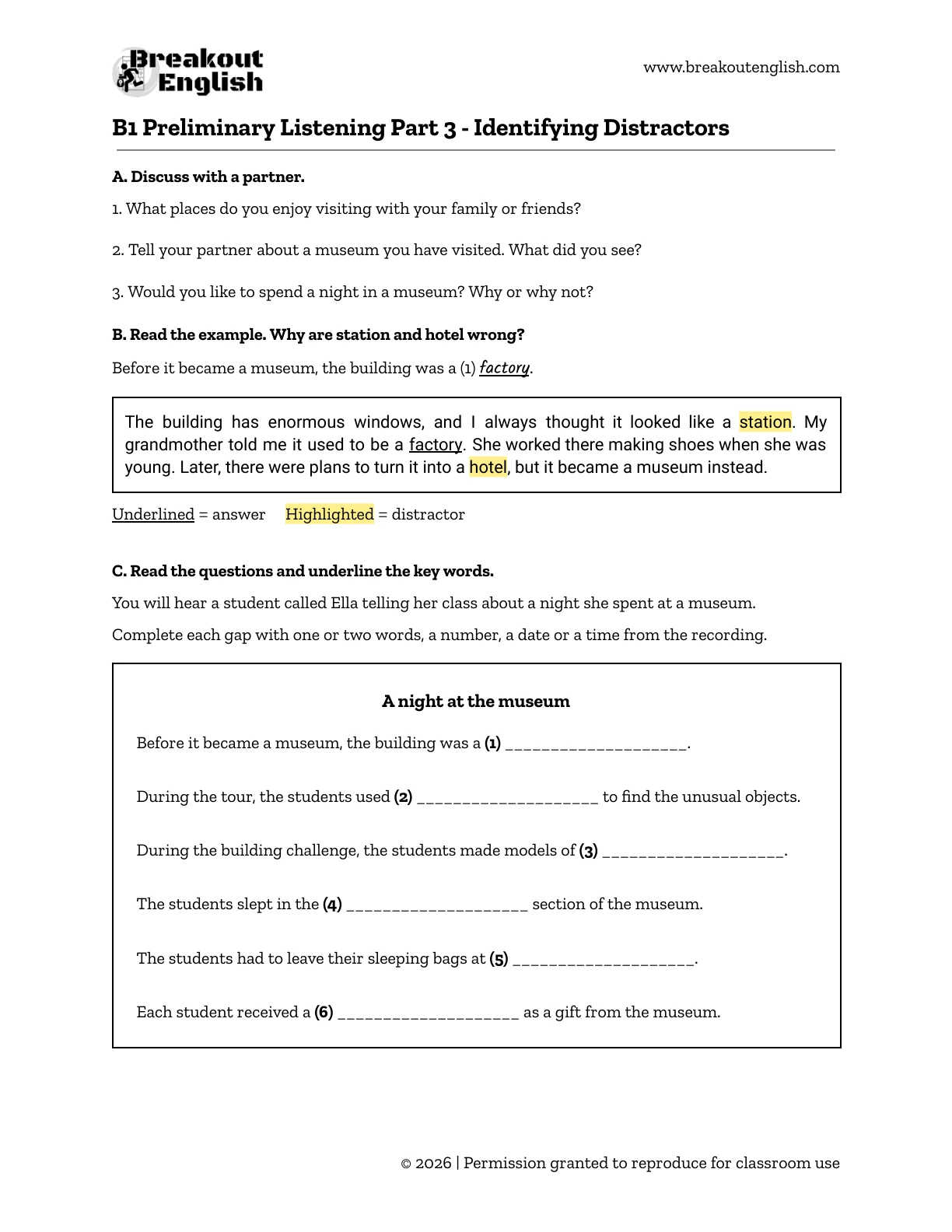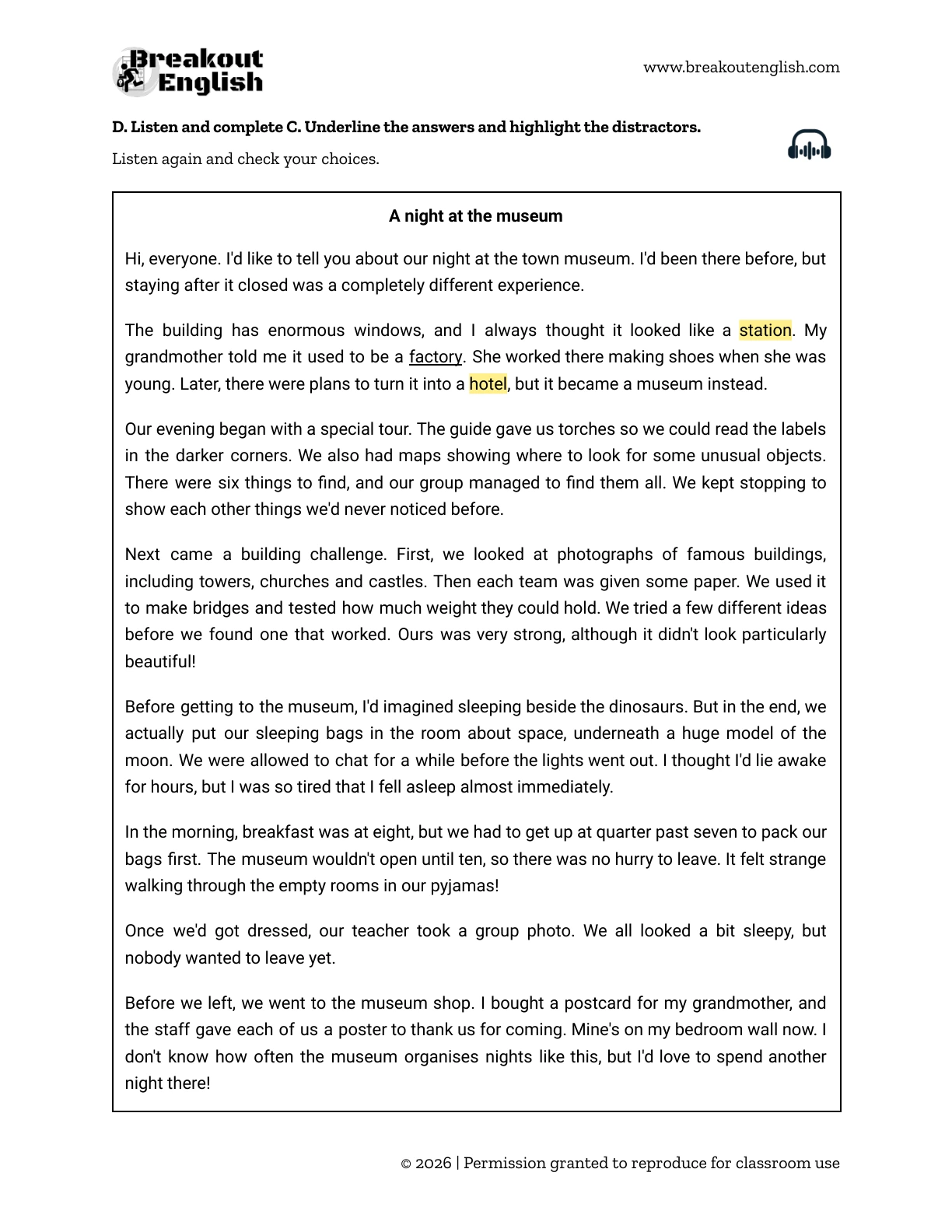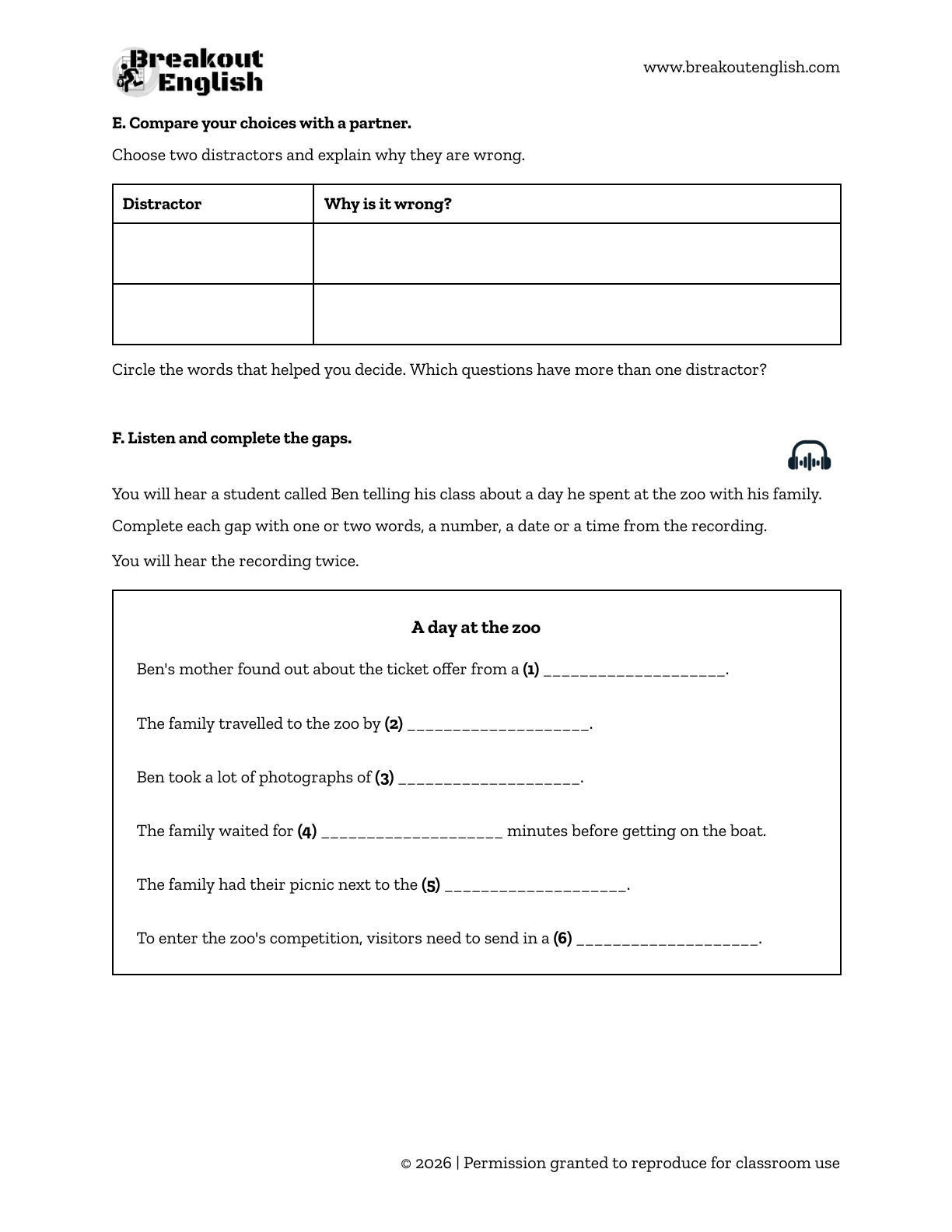
B1 Preliminary Listening Part 3 can be really frustrating when you hear several possible answers for the same gap. You know the words, you understand the story, and then you still choose the wrong detail. The problem is distractors. Distractors are present across Cambridge exams, but B1 Preliminary Listening Part 3 is one of the areas where they stand out the most. In these activities, a night at a museum and a family trip to the zoo give students practice in working out which information belongs in each gap.

Contents
What does B1 Preliminary Listening Part 3 test?
In this part, you listen to one person speaking and complete six gaps. The answers are specific details, such as places, objects, times, dates or numbers. Each answer is one or two words, a number, a date or a time.
You have time to read the questions before the recording begins, and you hear it twice. Use that reading time to work out what each gap needs. If the question asks when an activity starts, you know that you should be listening for a time. That helps narrow things down a bit, but the speaker might mention two or three different times. This is where identifying distractors comes in.
Identifying distractors in B1 Preliminary Listening Part 3
A distractor is a detail in the recording that could tempt you into writing the wrong answer. It will fit the gap grammatically and make perfect sense on its own, but it won’t answer the question in the right way. To defeat distractors, you need to check what the speaker says about them.
A distractor can be true information. It is wrong because it answers a different question.
Let’s take a night at a museum from our materials below as an example. If you’ve seen Night at the Museum, you’ll know that sleeping beside a dinosaur skeleton could mean becoming a midnight snack. Fortunately, Ella’s museum visit is a little less eventful.
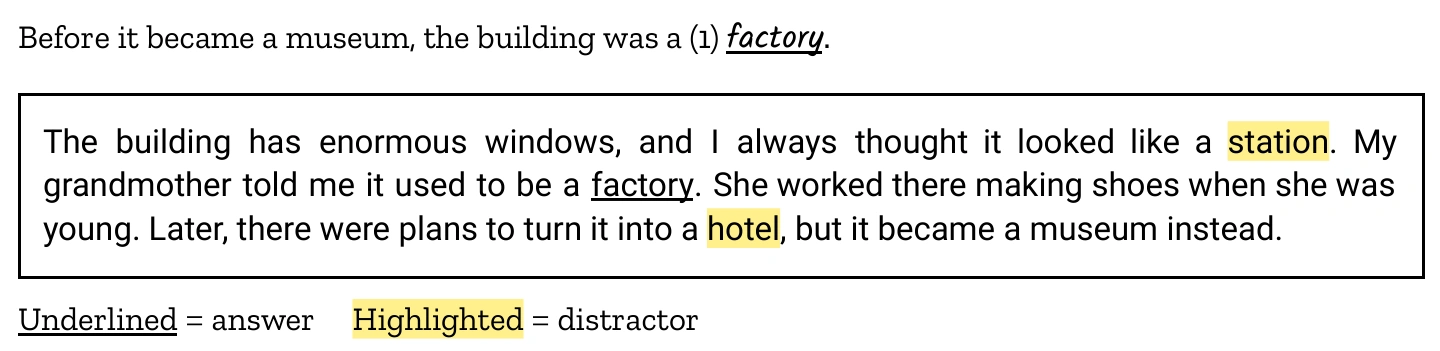
The question asks what the building was before it became a museum. Look at the extract from the worksheet. The answer is underlined and the distractors are highlighted.
Audio sample: Listen to Ella’s introduction and the museum-building example.
There are three possible building words, but they describe different things:
- Station: what Ella thought the building looked like. She doesn’t say that it was a station.
- Factory: what the building used to be. Her grandmother even worked there making shoes. This answers the question.
- Hotel: what people planned to turn it into. Those plans never happened.
All three words could fit after “the building was a”, so grammar alone won’t give you the answer. The phrases looked like, used to be and there were plans to tell you how each word relates to the building.
This also shows why it’s risky to write the first suitable word and stop listening. There can be more than one distractor for a gap, and the answer can come before or after them. In this example, the correct answer comes between the two distractors.
How to check a possible answer
- Read the whole question and underline the words that tell you what to listen for. Is it asking about a plan, a final decision, a place or a particular time?
- Listen to the explanation around a possible answer. A word may fit the gap but refer to someone else, or a different activity or an idea that changed.
- Keep listening to the recording even after you hear a likely answer. The speaker may correct it or give another detail that helps you decide.
- Use the second listening to check your choice against the question. Ask yourself why the other detail is wrong.
If your students also tend to choose answers because they recognise a word in the text, our B1 Preliminary Reading Part 3 distractor activities practise a similar skill. The surrounding meaning matters in both tasks.
The materials
The worksheet starts with a short discussion about museums and days out. Students then look at the building example before tackling the museum listening. They have the entire script to work with: they underline the answers, highlight the distractors and compare their choices with a partner.
With the full script, students have time to see how the distracting information works during the whole recording. Make them compare answers and distractors, and ask them to explain what each distractor refers to. Saying “It’s wrong” doesn’t tell you very much.
The final activity is a separate exam task about Ben’s family trip to the zoo. Students can apply what they’ve noticed without having the script in front of them.
You’ll need the worksheet and both full recordings below. Each MP3 contains one play of its listening task. Play the zoo recording twice for exam practice. The short museum sample in this post is just a preview. Download the full tracks for the activities.
EXAM PART: B1 Preliminary Listening Part 3
EXAM SKILLS: Listening for specific information; identifying distractors
LEVEL: B1
TOPIC: Museums, zoos and family days out
TIME: 40–50 minutes
PREPARATION: One worksheet per student and both recordings ready to play
Download

Preview