
A good film review tells the reader what a film is about, explains what works or does not work, and helps them decide whether to watch it. If you are learning how to write a film review in English, the main challenge is balancing a short summary with your own evaluation. Below, you will find a flexible paragraph plan, useful film vocabulary, example sentences and a short model review. The free PDF includes discussion questions, adjective practice, two writing tasks and an answer key with model answers. It is designed for B2 learners and can also support C1 writing practice.

Contents
How to structure a film review
A four-paragraph plan is a useful starting point for a short review. It is not a compulsory paragraph count for every exam. Organise your ideas around the question and the reader: a task about an interesting character needs more character analysis, while a task about a film’s message needs more discussion of that message.
- Introduction: name the film, give its genre and introduce your overall impression.
- Brief summary: explain the situation, setting and main characters without revealing the ending.
- Evaluation: discuss the elements that matter to the task and support your opinions with examples.
- Recommendation: say who would enjoy the film and why.
1. introduction
Give the reader a quick idea of the film. Include the director, release year or actors when they are relevant; you do not need to list every detail in a short exam review. A title such as “The Last Train: a mystery worth watching” makes the topic clear and suggests your opinion.
Example: “The Last Train is a mystery film set in a seaside town. It follows a young journalist investigating an old friend’s disappearance.”
2. brief summary
Describe the main situation and the character’s challenge. Two or three sentences may be enough. Keep space for evaluation and avoid explaining every event or revealing the ending.
Example: “When Maya finds a forgotten photograph, she begins to question people she once trusted. Her investigation gradually uncovers the town’s secrets.”
3. evaluation
Explain your opinion throughout the review, including this paragraph. Choose one or two relevant elements, such as the main character, acting, plot, soundtrack or visual effects. Then explain the effect on the viewer. You do not need to evaluate every aspect of the production.
Vague: “The acting is good.”
More useful: “The actor makes Maya’s fear believable, so we understand why she hesitates before confronting her friend.”
4. recommendation
End with a clear judgement and identify the audience. A recommendation can include a reservation: a film may be enjoyable for mystery fans but too slow for someone who wants action.
Example: “I would recommend it to fans of thoughtful mysteries, although viewers looking for constant action may find it slow.”

Useful film review vocabulary
Choose words that express what you mean and connect them to a specific feature. Several of the adjectives in the worksheet depend on context: low-budget describes the cost of production, and violent describes the content. Neither automatically means that a film is bad. A slow pace can feel dull or create tension.
- Plot: original, predictable, confusing, suspenseful, thought-provoking.
- Acting and characters: convincing, believable, memorable, weak, unconvincing.
- Pace: gripping, fast-paced, slow, repetitive.
- Visuals and sound: impressive special effects, striking cinematography, an atmospheric soundtrack.
- Overall impression: entertaining, moving, disappointing, first-rate, second-rate.
Examples: “The plot is predictable, but the convincing performances make it enjoyable.” “The atmospheric soundtrack builds tension even when very little happens.”
Useful phrases
- Introduce: “The film is set in…” / “It tells the story of…” / “It stars…”
- Evaluate: “The strongest feature is…” / “What makes the character interesting is…” / “The main weakness is…”
- Contrast: “Although the opening is slow,…” / “Despite its predictable plot,…”
- Recommend: “I would recommend it to…” / “It is worth watching if…” / “It may not appeal to viewers who…”
Use the present simple to describe the story: “Maya returns home.” Use the past simple for your viewing experience or production details: “I watched it last weekend.” “It was released in 2024.” For more ways to connect ideas, see our guide to linking words.
Film review example
This original practice example uses an invented film, The Last Train. It answers a task asking what the film is about, why its main character is interesting and whether you would recommend it. Notice how little of the review is devoted to retelling the plot.
The Last Train - a mystery worth watching
The Last Train is a mystery film set in a small seaside town. It follows a young journalist, Maya, who returns home to investigate the disappearance of an old friend. If you enjoy stories that keep you guessing, this could be a good choice.
After finding a forgotten photograph, Maya starts questioning people she once trusted. The story moves between her investigation and memories of their school days, gradually revealing why the town has kept its secrets.
The strongest feature is Maya herself. She is determined but makes believable mistakes, which makes her easy to care about. The quiet soundtrack builds suspense, although the middle section is rather slow. A few scenes could be shorter without losing anything important.
Despite this weakness, I would recommend The Last Train to fans of thoughtful mysteries. It offers an engaging main character and enough surprises to keep you interested. However, viewers looking for constant action may prefer something faster.
Film reviews for B2 First and C1 Advanced
A review is one of the possible task types in Writing Part 2 of B2 First and C1 Advanced. A film review is not compulsory, and a review question may be about something else. Read the actual task before choosing it.
- B2 First: write 140–190 words.
- C1 Advanced: write 220–260 words.
- For either exam: cover every point in the question, write for the stated reader and develop your opinions with reasons or examples.
You can check the official B2 First format and C1 Advanced format.
Common mistakes in film reviews
- Too much plot: keep the summary short and use the remaining space to evaluate the film.
- Opinions without reasons: replace “It was amazing” with a specific feature and its effect on you.
- Missing part of the task: if the question asks about the main character, explain what makes that character interesting.
- “An action film”, not “a action film”: choose a or an according to the next sound.
- “I recommend watching it”, not “I recommend to watch it”: alternatively, write “I would recommend it to anyone who enjoys mysteries.”
- “Based on”, not “based in”, for a source: “The film is based on a novel.” Use “set in” for a setting: “It is set in London.”
Before you finish - a film review checklist
- Have I answered every part of the question?
- Is the summary brief and free of spoilers?
- Have I supported my opinions with reasons or examples?
- Does the style suit the intended reader?
- Have I made a clear recommendation?
- Are the paragraphs easy to follow, and have I checked the word count, grammar and spelling?
The materials
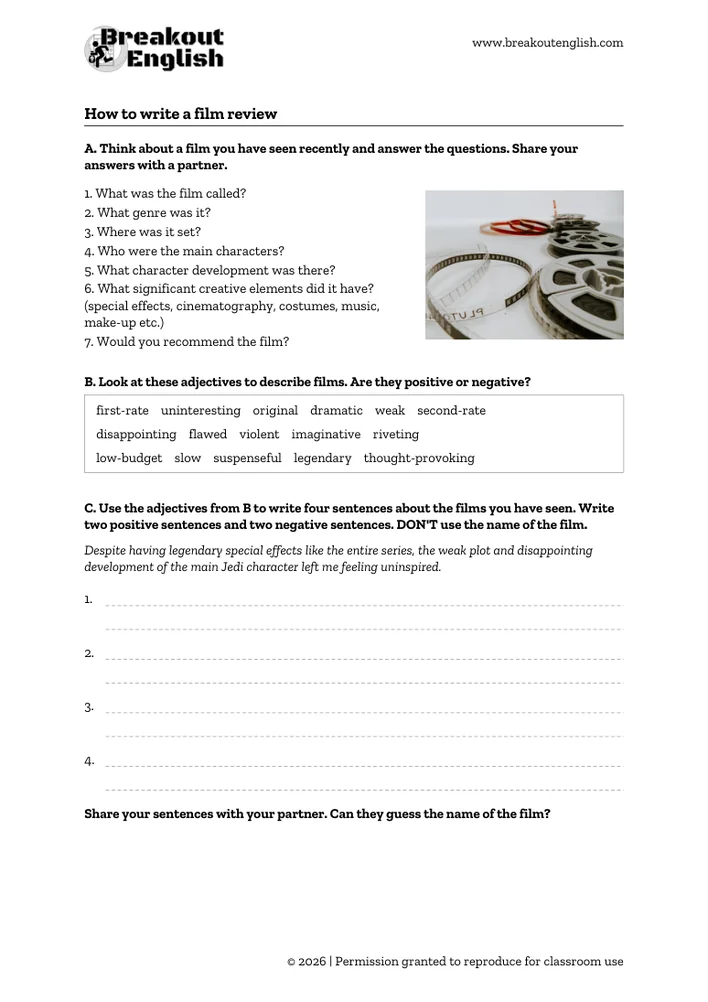
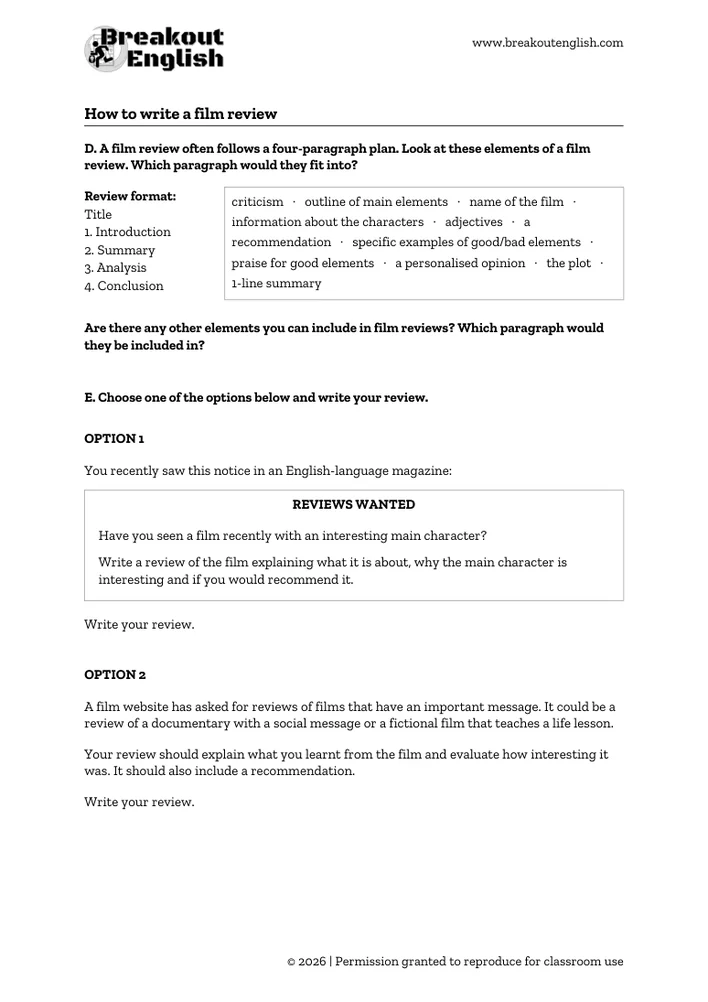
The three-page film review worksheet takes students from discussing a film to writing their own review. It includes:
- Discussion questions about a film students have seen.
- Adjectives to classify and use in short descriptions.
- A guessing activity using positive and negative sentences about films.
- A paragraph-planning task and two review prompts.
- An answer key and complete models for The Accountant and The Pursuit of Happyness.
For a classroom lesson, start with a short discussion about films, then work through the vocabulary and planning tasks. Ask students to explain their adjective choices, especially when a word could be positive, negative or neutral in context. Give the writing task in class or for homework.
Use the models to discuss how the writer answers each prompt and supports their opinions. They are examples for analysis rather than a fixed formula or a promised exam score. For timed exam practice, apply the relevant word limit and ask students to use the checklist above.
LEVEL: B2; adaptable for C1.
SKILLS: Writing, film vocabulary, evaluation and recommendations.
TIME: 45–60 minutes for preparation, with additional time for writing and feedback.
PREPARATION: Print or share pages 1–2 with students. Keep page 3 for feedback and model analysis.
Download

Preview

First Writing Plus
Practise B2 First Writing with guided tasks, model answers and language work for essays, articles, reviews, letters, emails, reports and stories.
Digital PDF: €9.95 · Also available in paperback

Interesting and useful material to be used in class.
thanks!