B2 First (FCE) Speaking Part 2 is also called the “long turn”. In fact, it’s only a minute long, but for B2 First candidates that minute can feel like an eternity. You have to talk about two pictures on your own and answer a question about them.
Having some useful phrases ready to go can make a big difference to your confidence going into the exam. Whether it’s strange pictures, strange questions or just nerves, this part of the exam causes a lot of anxiety for many candidates. However, it is very trainable. So, what can we do to help?
In addition to the free materials on this page, you can find 5 complete First (FCE) Speaking exams as part of Breakout English’s premium materials collection.

Contents
What do you have to do in B2 First Speaking Part 2?
The examiner gives you two photographs and asks you to compare them and answer a question. You have one minute to speak without interruption. The question is also printed above the photographs, so keep it in mind while you’re talking.
Your partner then answers a short question about your photographs for about 30 seconds. You swap roles with a different pair of photographs. Remember to practise the short response too.
Don’t spend the whole minute describing every object in the first picture. You need time for both photographs and the question.
How to train for B2 First Speaking Part 2
First and foremost, you’ll need lots of practice with this part of the exam. Remember, a B2 level speaker is not always completely confident in their own ability, despite often having quite a substantial bank of language to draw upon.
Get prepared with structures and useful phrases to organise the long turn. Unlike our Preliminary (PET) picture description plan, I don’t recommend a strict plan at this level, but rather a helping hand with language. Briefly introduce what the photographs have in common, then compare them while answering the question.
Give yourself a reason to use the target language. In a classroom, give one student a checklist of language and ask them to cross off phrases their partner uses. Turn it into a game, but only give a point when the phrase fits the meaning. “Whereas” needs a contrast. It can’t do all the work for you.
Be strict about time limits. It’s easy to ramble on about pictures for more than a minute, but that’s not what will happen in the exam. You need to organise and complete the task within the given time. Stop your partner with your best Cambridge examiner “thank you”.
Practise vocabulary related to the topic. After studying a vocabulary unit, find some pictures connected to it. Write useful words down or put them on the board for the first attempt, then remove the support. Aim for variety and accuracy rather than complicated words you aren’t sure how to use.
Practise again. Practise as a warmer, cooler, filler and inbetweener. Practise with a teacher, a friend, the mirror or your dog. In the classroom, make the students the examiner in groups of three and practise like that.
When you’re ready, you should be tired of seeing pictures. If you’ve prepared well, you could almost do it with your eyes closed, but then you wouldn’t be able to see the pictures.
B2 First Speaking Part 2 useful phrases
Other than vocabulary related to the topic of the pictures, it helps to have a selection of useful phrases to organise the long turn, compare and speculate. You don’t have to use every expression. Choose the ones that help you explain your ideas.
Referring to the photographs
- There are two pictures of…
- In the first picture… / In the second picture…
- In both pictures…
- The first one… / The second one…
- The picture on the left/right…
- The picture at the top/bottom…
Comparing and contrasting
- Both pictures show…
- One similarity is that…
- …but…
- On the other hand…
- In contrast…
- …whereas…
- …while…
- The other picture is different because…
For example: “The people in the first picture are shopping outdoors, whereas the woman in the second picture is inside a shop.” Use and to add information and so to give a result. They are useful linking words, but they don’t show a contrast.
Speculating
- Possibly… / Probably…
- They might be… / They may be… / They could be…
- It’s likely that… / It’s possible that…
- I guess… / I imagine… / I suppose…
- Maybe… / Perhaps…
- It looks like… + a noun
- They look/seem to be… + -ing
- It looks as if… + a clause
“They might have chosen the market because the food is fresh” gives a possible reason and answers the shopping question. Base your ideas on what you can see.
B2 First Speaking Part 2 example
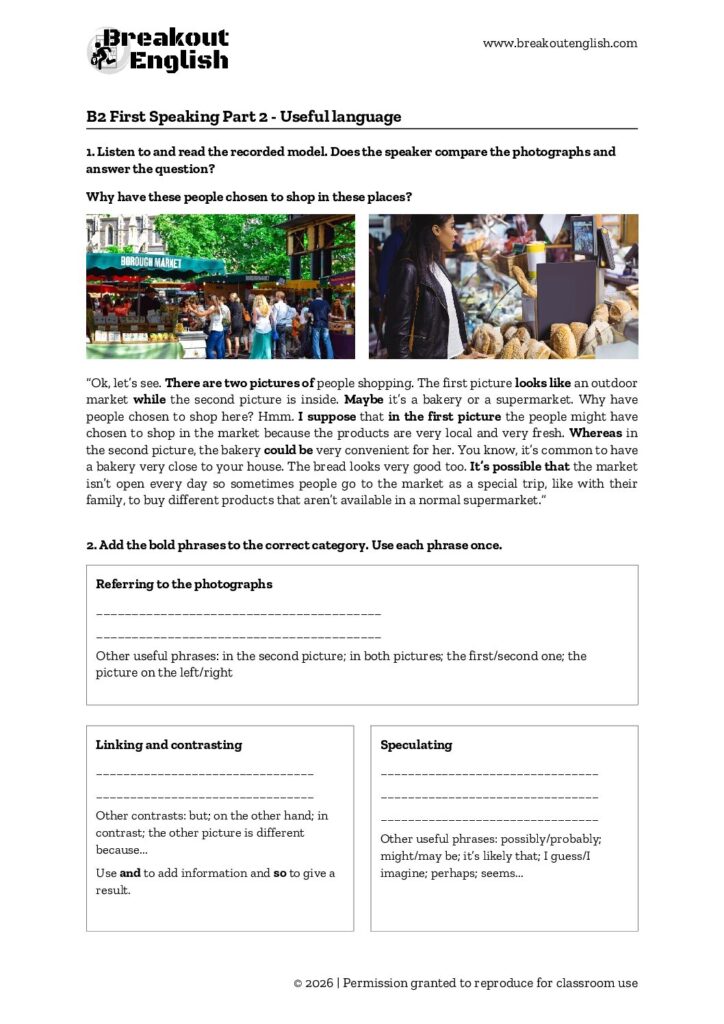
Here is an example using the shopping photographs from the worksheet. The examiner asks you to compare them and explain why the people might have chosen to shop in these places.

You could begin: “Both pictures show people shopping for food, but the places are quite different. The first looks like an outdoor market, whereas the second seems to be a bakery. The people at the market might want fresh, local products. On the other hand, the woman in the bakery may have chosen it because it’s close to her home and convenient.”
This is a starting point for your one-minute answer. Develop it with more detail about the products or how often people shop there. Your partner’s shorter question asks where they would prefer to shop and why.
The materials
These materials have been designed to provide your students with useful language for the exam and practice with different pictures. The topic of all the pictures is shopping, so they would fit in perfectly with a shopping unit in a coursebook.
The two-page worksheet includes a recorded model and language task, three further pairs of photographs, a partner question and an answer key. The audio is available separately below.
Classroom procedure
- First, listen to the example. Does the speaker compare the photographs and answer the question? I’d recommend folding the worksheet here or only projecting the images.
- Read the model and categorise the bold phrases. Check the answers using the key at the bottom of page 2.
- Give feedback on the useful language and drill some pronunciation.
- Practise in pairs with the three further sets of photographs. Give each speaker one minute to compare the pair and answer its question.
- After each turn, the partner answers the worksheet’s follow-up question about where they would prefer to shop and why. Allow about 30 seconds, then swap roles.
For more practice, try our B2 First Speaking Part 2 pictures. As an extension, students can brainstorm different follow-up questions and practise answering them.
You can also use these materials to practise on your own. Work through the tasks and record the speaking parts on your mobile phone. A day or two later, listen again and check whether you compared both photographs and answered the question. You’ll hate listening to yourself at first, but the effort will pay off.
EXAM PART: B2 First Speaking Part 2
EXAM SKILLS: Comparing, speculating, discourse management
TOPIC: Shopping
TIME: 20–25 minutes + extra practice
PREPARATION: One copy of the two-page worksheet per student, a timer and a speaker or computer to play the audio
Download


Preview