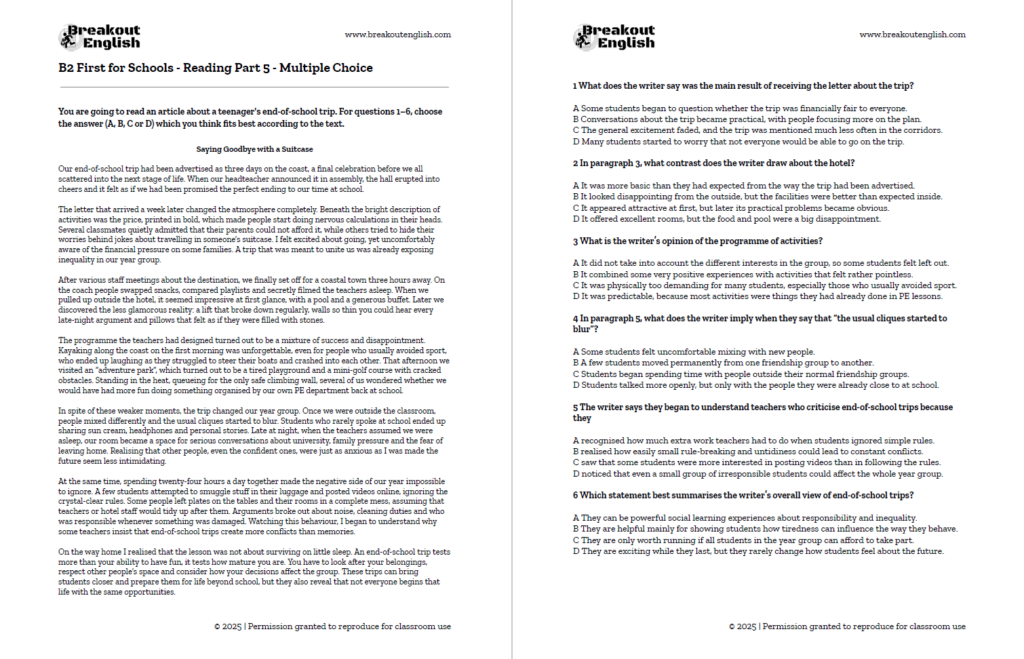
Cambridge B2 First (FCE) Reading Part 5 is deceptively challenging. It comes across as a simple multiple choice task, but the difficulty lies in the level of the reading text, the complicated questions, and the fact that each question is worth 2 points. Don’t take it for granted that it will be easy just because it’s multiple choice. This task requires careful reading, critical thinking, and elimination skills to succeed. Read about how to go about this task, then try out our two Reading Part 5 pdfs to test your skills, one for the regular B2 First exam and one Reading for the B2 First for Schools exam.

Contents
What is B2 First Reading Part 5?
Reading Part 5 consists of a long text (about 500-600 words) followed by six multiple-choice questions. Each question has four options (A, B, C, or D), but only one correct answer. The questions test:
- Understanding specific details
- Identifying opinions and attitudes
- Recognising implications and inferences
- Grasping the overall meaning of parts of the text
This task requires systematic reading, meaning you should approach it step by step rather than reading everything at once. The wrong answers are designed to distract you, so you must develop a strategy to eliminate them effectively.
Understanding the four question types
Each question in B2 First Reading Part 5 falls into one of four categories. Understanding the differences between these types will help you develop an effective strategy for answering them correctly.
Understanding specific details
These questions require you to locate precise information in the text. The answer is usually directly stated, but you may need to paraphrase or match synonyms to find it. Avoid being misled by distractors that use similar words but change the meaning.
Identifying opinions and attitudes
These questions focus on what the author or a character thinks or feels. Look for words that express opinion, agreement, disagreement, or bias rather than just facts. Pay attention to adjectives, adverbs, and modal verbs, as they often show tone and perspective.
Recognising implications and inferences
Unlike detail questions, inference questions require you to read between the lines. The answer may not be explicitly stated, but clues within the text will guide you to the correct conclusion. Be cautious of extreme interpretations that go beyond what the text suggests.
Grasping the overall meaning of parts of the text
Some questions ask about the main idea or purpose of a paragraph or section. Rather than focusing on minor details, consider what the passage is communicating. Identifying transitional words and topic sentences can help you determine the correct answer. However, this type of question is less common and when it appears, it is normally the last question, number 6.
How to approach the task systematically
Many students try to read the entire text first and then answer the questions. While this can work for some, a structured method will help you avoid confusion and time pressure. Instead of reading the full text immediately, start by looking at the first question and its four answer choices. This will give you a clear idea of what to focus on when reading.
As you read the text, keep the question in mind and look for relevant keywords or paraphrased ideas. Rather than rushing through, identify the key section in the text that relates to the question. Once you think you’ve found it, read it again carefully and try to predict the answer before looking at the options.
When analysing the answer choices, compare them carefully with the key section of the text. Consider which option best matches the meaning, and be wary of extreme or misleading words that could make an option incorrect. If you can confidently eliminate wrong answers, your chances of selecting the correct one increase significantly.
To avoid overwhelming yourself, tackle the questions one by one, always referring back to the text as needed. This structured approach ensures that you remain focused and avoid unnecessary confusion.
Avoiding distractors
Cambridge is known for using distractors in B2 First (FCE) Reading Part 5 to trick careless readers. One common technique is including words or phrases in the wrong answers that closely resemble those found in the text. These options may look correct at first glance but often change the meaning slightly, making them incorrect. Be especially cautious of answers that use synonyms or paraphrased language, as they might not accurately reflect what the text says.
Another typical Cambridge trick is including answers that are partially correct but miss a crucial detail. For example, an option may state a fact mentioned in the passage but not in the exact context required by the question. Always double-check that your chosen answer fully aligns with the meaning of the relevant part of the text.
When eliminating wrong answers, ask yourself: Does this answer correctly reflect the meaning of the text? If there is any doubt, it is likely a distractor. Comparing the subtle differences between answer choices will help you avoid falling into these traps.
Common mistakes and how to avoid them
Reading everything before looking at the questions can be inefficient. Instead, read with a purpose by checking the questions first. Another common mistake is choosing an answer simply because it contains the same words as the text. Cambridge often uses synonyms or paraphrases, so look for meaning rather than exact matches.
Failing to eliminate incorrect answers can reduce your chances of success. Narrow down your choices by crossing out options that do not match the text’s meaning. Additionally, spending too much time on a single question can be detrimental. If you’re stuck, move on and come back later rather than overthinking.
Top tips for success
- Highlight key words when reading the text and questions to quickly identify relevant information.
- Eliminate wrong answers to improve your chances of selecting the correct one.
- Tackle each question individually to prevent information overload.
- Think about the author’s opinion and tone, as many questions focus on attitude, opinion, and implication, not just facts.
- Use context to understand difficult words. You don’t need to comprehend every word but should deduce meanings from the surrounding text.
- Manage your time effectively. Aim to spend around 12 minutes on Part 5 to ensure enough time for the rest of the paper.
The materials
B2 First Reading Part 5 is deceptive. People tend to think it’s the easy part because it’s multiple choice. They couldn’t be more wrong. A lot of work goes into these texts to make them challenging at exactly the level that Cambridge is testing. Here, you have two Reading Part 5 texts, one for the regular exam and one for the for Schools version. Use them to test yourself or your students after training them on the techniques of the exam. Or use them to do the training itself by scaffolding a lesson around these readings, highlighting the importance of eliminating wrong answers, underlining details and going one-by-one through the answers.
EXAM PART: Reading
EXAM SKILLS: Understanding detailed and overall meaning, the writer’s opinion, attitude and purpose, implied meaning from context
TOPIC: First – Healthy living, First for Schools – School trips
TIME: 15 minutes without scaffolding, 30+ with scaffolding
PREPARATION: One copy of the worksheet per student
Download