If you’re preparing for B2 First for Schools Writing Part 2, you might get a story as an option. That sounds nice and easy, doesn’t it? But be careful, a story is marked on the same key areas as the other options: content, communicative achievement, organisation, and language. In other words, even though it seems like a more accessible task, you still need a clear structure, lively language, and a story that’s easy to follow.
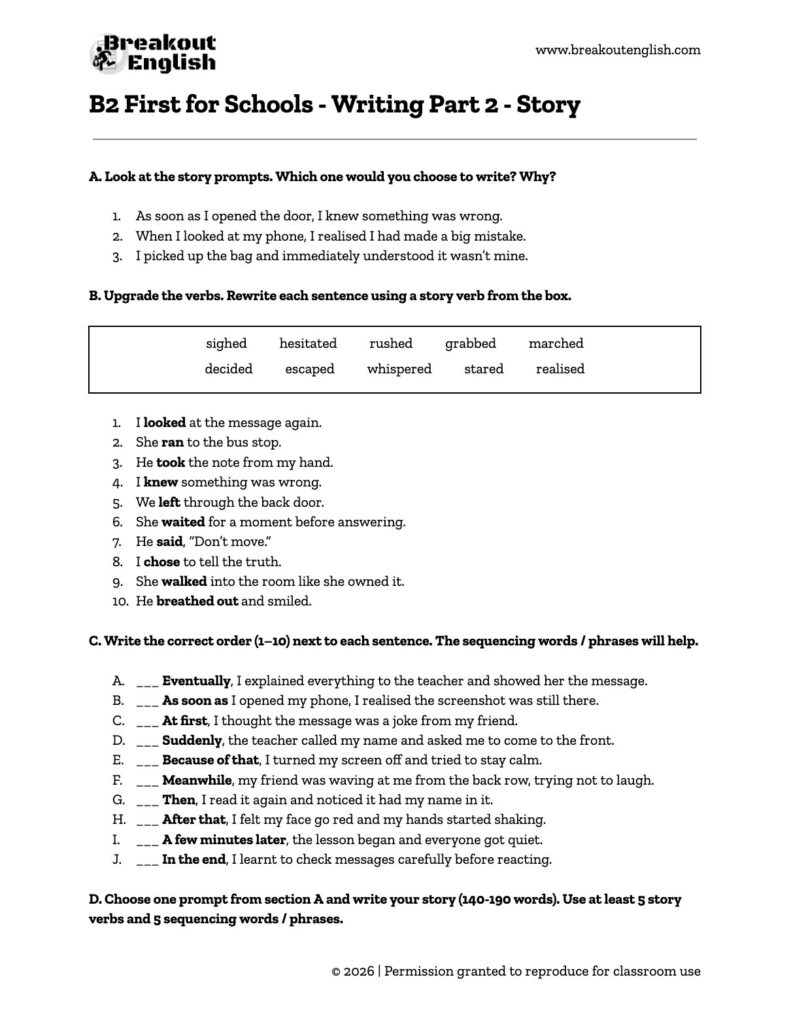
This post and the downloadable materials show you a simple way to improve your B2 story writing with two fast upgrades. First, stronger story verbs, so your writing sounds more natural and interesting. Second, clear sequencing words (so your story is organised and easy to read.

Contents
What is the story task in B2 First for Schools?
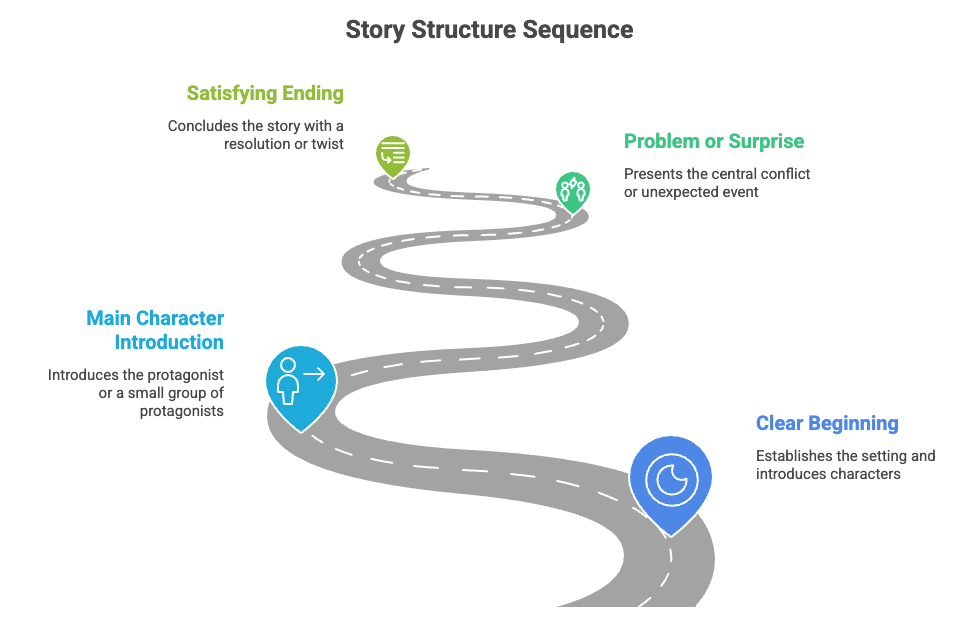
In B2 First for Schools Writing Part 2, the story task usually gives you a prompt sentence (the first sentence of your story). Your job is to continue the story in a clear, engaging way. A good B2 First for Schools story usually has:
- a clear beginning, middle and end
- one main character (or a small number of characters)
- a problem or surprise (the main event)
- a satisfying ending (a final moment, feeling, lesson, or small twist)
Most importantly, your story should feel like a story, not a description, not a list of events, and not a random collection of ideas. If you’ve got a good imagination, this could be a good task for you.
Common mistakes in B2 story writing
- Making the story too boring – A very common problem in B2 story writing is that the plot is simple, and the language is flat. Use your imagination and remember that a story should be fun to read.
- Going overboard with the plot – Some students try to make the story “amazing” and add too many characters, locations, and events. The result is often confusing. A simple plot written clearly is better than a complicated plot written badly.
- Forgetting the prompt sentence – In the exam, the prompt sentence is your starting point. If your story doesn’t follow naturally from the first sentence, you lose content and coherence. You can’t turn everything into a story that ends with a surprise birthday party.
- Language mistakes that lower scores – Using tenses randomly, basic vocabulary, and poor paragraphing or punctuation can easily stop you reaching passing marks for B2 language. Getting the basics right is essential.
How to improve your B2 First for Schools stories
The fastest way to improve a B2 First for Schools story is to make your story clearer, more natural, and more engaging for the reader. Examiners love stories that are easy to follow and feel like “real English”, even if the idea itself is simple. The sweet spot for a story is a simple plot with a clear beginning, a problem, a reaction, and a satisfying ending. After you get the basic structure right, you can improve it with better language choices.
One simple upgrade is to stop relying on basic verbs like go, get, do, make, look, and say. These verbs aren’t wrong, but they don’t create much atmosphere. Strong story verbs make your writing more vivid and more natural, especially at key moments like the problem, the turning point, or the ending. Used well, they help your story feel more confident and more B2 level. So, instead of make, use construct, instead of look, use admire, instead of say, use whisper. These verbs add more drama and intrigue to your stories.
Another upgrade is sequencing. Stories are essentially a series of events in a clear order. If your reader has to work extra hard just to understand what happened first, what happened next, or why something happened, your story will feel messy. A few good sequencing words and phrases (e.g. a few minutes later, suddenly, eventually) guide the reader through the plot and make your organisation stronger. The trick is not to start every sentence with a linker, just add them where the story needs it, particularly when time changes, something surprising happens, or you want to show cause and effect.
Try the materials below to practise story verbs and sequencing words to improve you B2 First for Schools writing.

The materials
These simple materials introduce several story verbs and several sequencing words / phrases. These can immediately be used in a practice story, based on a few possible prompts. Keep in mind what Cambridge are looking for, tick all the boxes, and you’ll find writing stories can actually be fun to write.
EXAM PART: Writing
EXAM SKILLS: Communicative Achievement
TOPIC: Stories
TIME: 45-60 minutes
PREPARATION: One copy of the worksheet per student
Download