Are you planning to take an English exam like B2 First or C1 Advanced and feeling overwhelmed by the prospect of writing a report? Let’s discuss the style and purpose of a report, the suggested format when you write a report for an exam, and useful phrases for reports. Finally, we’ve got some free downloadable materials to learn useful phrases for reports and sample writings to practise at home.

Contents
Style and purpose of a report
The style of a report should be formal and objective, presenting information in a clear, concise, and logical way. The purpose of a report is to communicate important information, findings, and recommendations to a specific audience in a structured and organised format. Support your findings and recommendations with relevant reasons and examples. In an exam report, these should fit the situation described in the question.
Reports in English exams are mini-replicas of what you would be expected to write in a professional context. These may be written for a company, a government organisation, or for a university/school setting.
How to write a report with paragraph headings
A report typically follows a specific format with paragraph headings that make it easier for the reader to navigate the content. In the real world, a report would probably be several pages long, with multiple sections, and packed full of data, graphs and conclusions based on those. Obviously, in 140-190 words for B2 First or 220-260 words for C1 Advanced you can’t do that, but it’s good to keep paragraph headings to split up the text into sections. One practical option is a four-paragraph plan, much like we have for many other writings.
- Introduction: This sets the context and outlines the purpose of the report.
- Main body 1: This contains the findings and analysis related to the topic.
- Main body 2: This contains further analysis and recommendations.
- Conclusion: This summarises the key points made in the report and a call to action for the main recommendations.
Choose headings that tell the reader what each section covers. For example, “Facilities” and “Recommended improvements” are more informative than “Main body 1” and “Main body 2”. Let the question guide your choices.

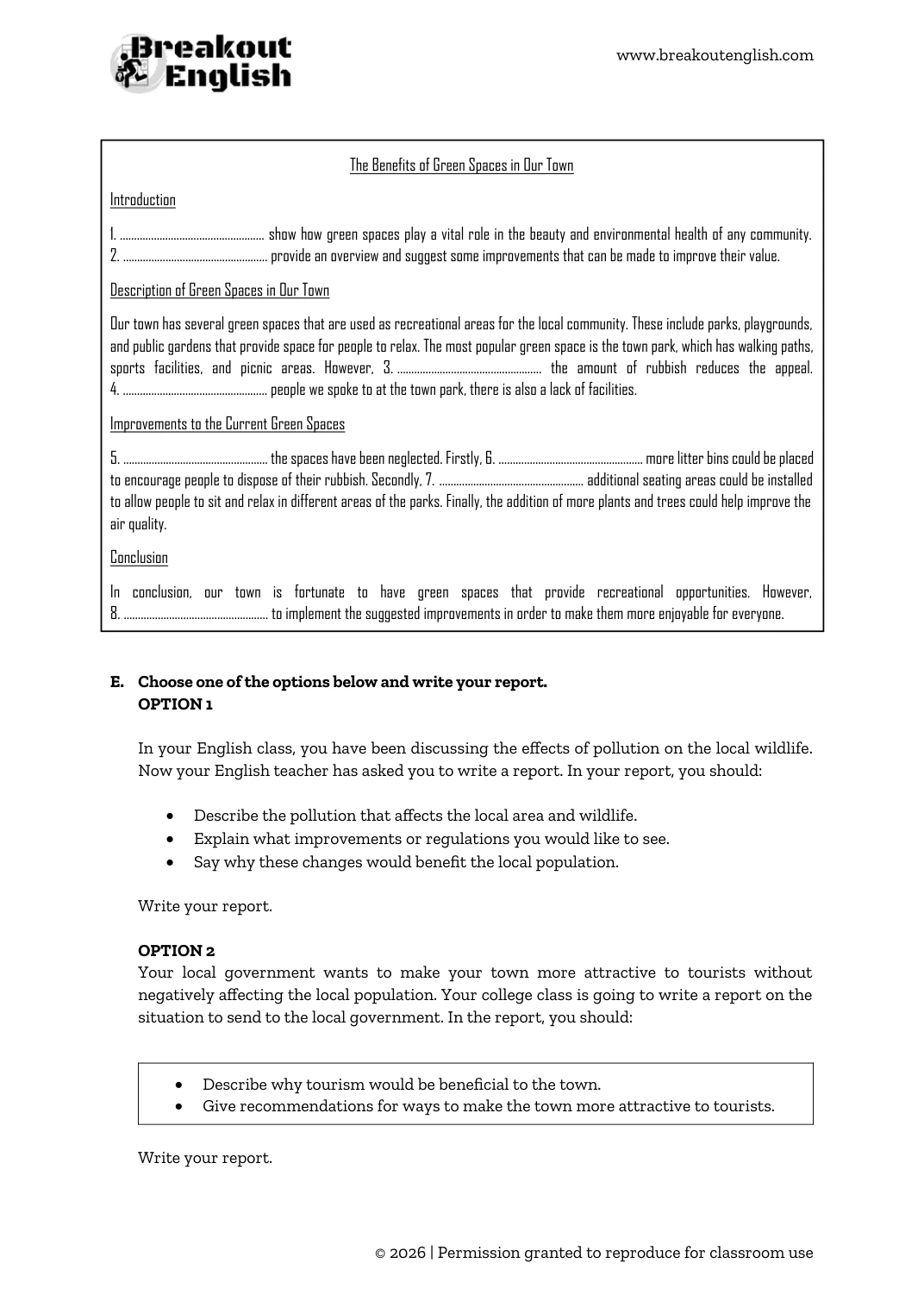
Paragraph headings should be descriptive and focussed on the content of each section. Both Introduction and Conclusion can be the headings of your first and last paragraphs, while the central ones can often be taken directly from the question. What headings would you use for this sample question?

Remember to include a title in your report as well. It doesn’t have to be exciting or engaging like an article, but it should describe what the report is about.
Seeing samples is a good way to learn how to write a report. This example is the answer to the question above.

Useful phrases for reports
To write a successful report, it’s essential to use appropriate phrases that convey your ideas clearly. There are often many ways to do this, but you will want to learn several of them for exam day. The useful phrases we recommend considering include:
- The aim of this report is to…
- This report considers several aspects of [topic] in order to…
- The findings of this report/survey are outlined below.
- One issue is that…
- The current situation is unacceptable because…
- According to several students/employees/clients…
- It was suggested that…
- The vast majority of students/employees/clients believe…
- I would therefore strongly recommend…
- Based on the above, the best course of action would be…
These phrases are all part of our downloadable materials below, so if you want more practice, check them out. With practice and dedication, you can write a successful report that impresses your examiners and earns high marks.
For more B2 practice with reporting findings, try our describing change and surveys worksheets. They focus on language you can use to explain the evidence behind a recommendation.
The materials
These materials can be used in class or individually. First, you’ll discuss the purpose of reports and some details. Then there is a quick task to learn some useful phrases for reports. Finally, you can test if you know how to write a report by trying one or both of the practice questions. Both questions include sample answers.
EXAM PART: B2 First and C1 Advanced Writing Part 2
EXAM SKILLS: Organising reports and using formal phrases
LEVEL: B2-C1
PREPARATION: One copy of the worksheet per student; keep the sample answers for comparison
Download
Preview