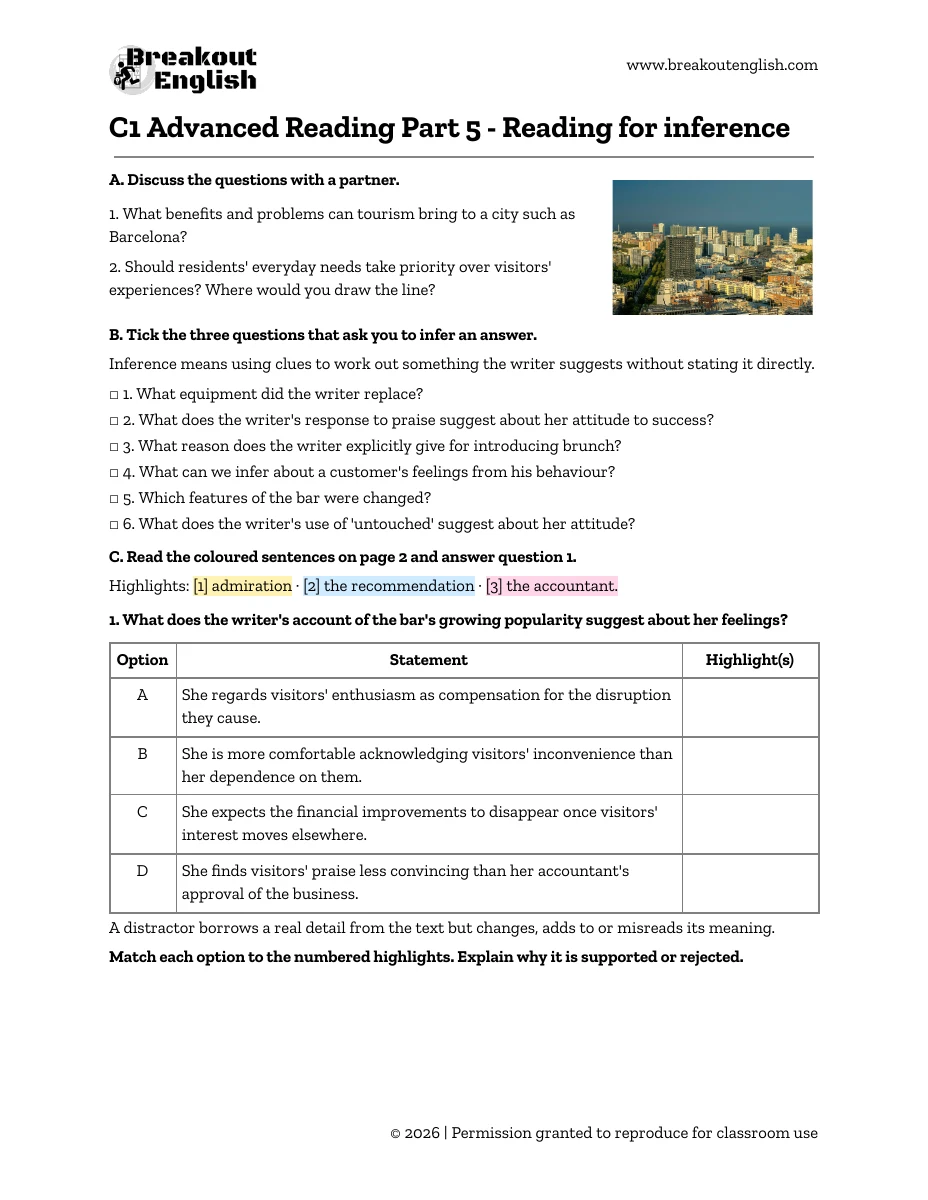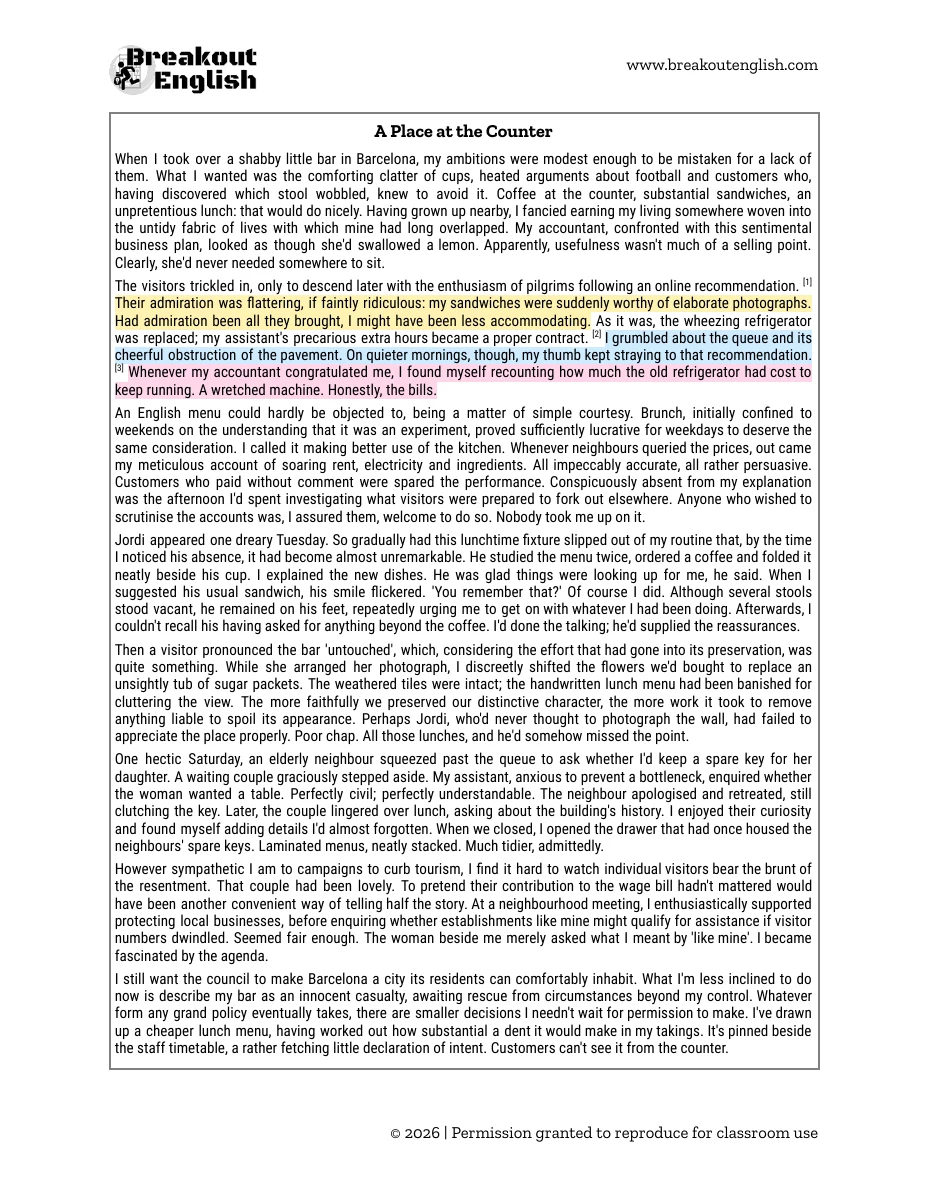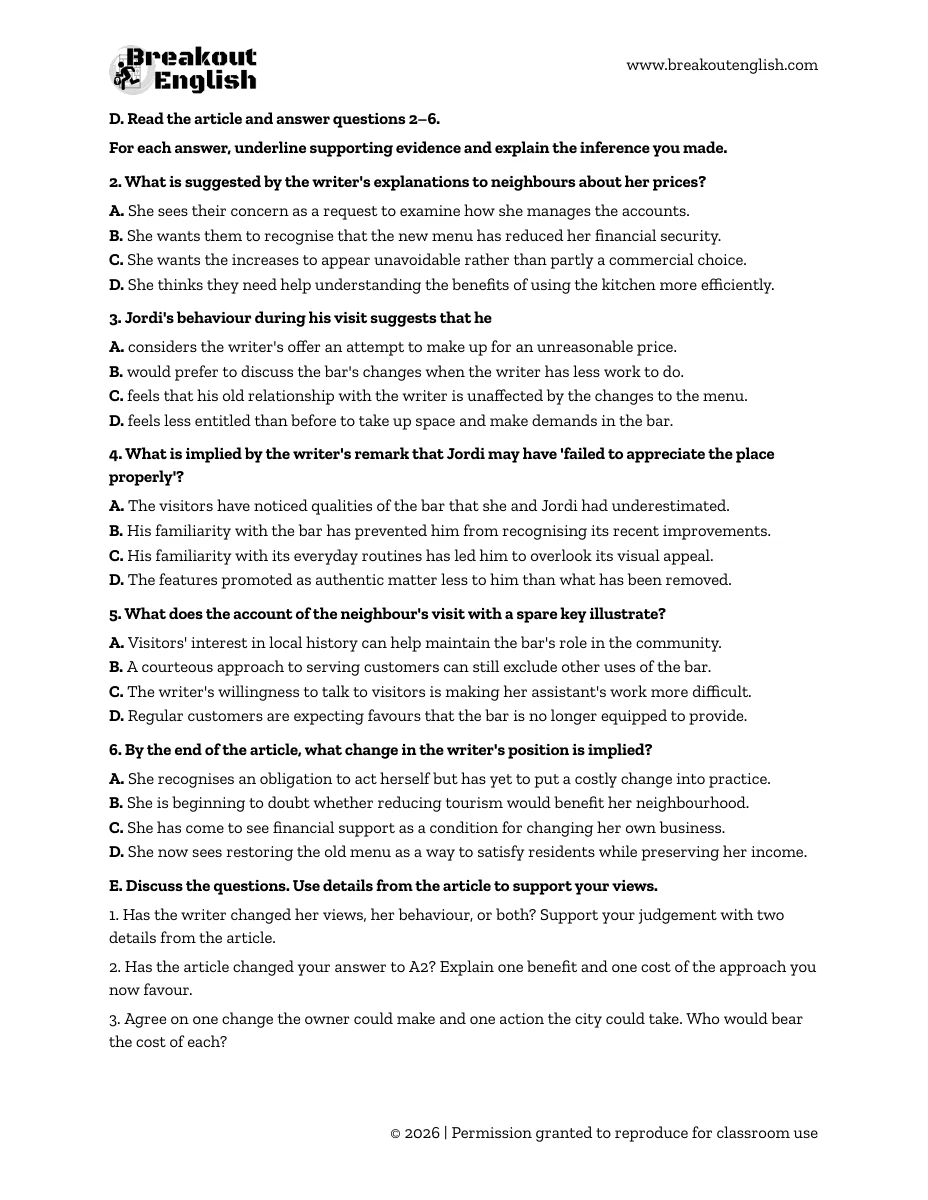
Someone says “It’s getting late” while you’re comfortably settled on their sofa. You probably don’t check your watch and congratulate them on their observation. You start thinking about going home. We infer meaning all the time, often without noticing. C1 Advanced Reading Part 5 asks you to bring that same awareness to a text, where the answer can be sitting between the lines while three very convincing wrong answers wave at you from the page.

Contents
Reading between the lines
Inference means using clues to work out something that hasn’t been stated directly. A friend keeps checking their phone during dinner. A colleague describes a disastrous meeting as “a productive use of everyone’s time”. A review praises a hotel’s location, then says remarkably little about the rooms. In each case, you start thinking about what the words or behaviour might suggest.
Of course, your friend might be waiting for an important message rather than finding you boring. Context matters. In a reading task, the text needs to give you enough evidence to choose one interpretation over the others. You’re reading between the lines, but you’re still reading the lines. You can’t just invent a story that sounds plausible.
At higher levels, you increasingly have to deal with meaning that is less direct. A writer can show resentment without using resentful, admit a mistake without announcing “I was wrong”, or praise something in a way that makes it clear they’re actually criticising it. Knowing every word doesn’t guarantee that you’ve understood the point.
Recognising implicit meaning is part of the Council of Europe’s description of C1. It isn’t a skill that suddenly appears at this level: you’ll also meet it in B2 First Reading Part 5. The challenge at C1 is the subtlety of the language, the relationships between ideas and the distinctions between possible interpretations.
Inference in C1 Reading Part 5
Part 5 has one text and six multiple-choice questions, each with four options. That’s the straightforward bit. The questions can focus on different aspects of meaning, as outlined in Cambridge’s C1 Advanced exam format.
| Question focus | What you’re trying to understand |
|---|---|
| Detail | A particular fact, explanation or event. |
| Opinion and attitude | What someone thinks, and how they feel about it. |
| Tone | Whether the wording is enthusiastic, doubtful, critical, ironic or something else. |
| Purpose | Why the writer includes a comment, example or description. |
| Main idea | The central point of a paragraph, section or whole text. |
| Implication | What the text suggests without saying it directly. |
These aren’t separate boxes that every question fits neatly into. You might need to infer someone’s attitude from their behaviour, or recognise irony to understand the writer’s purpose. A question can involve several reading skills at once, and there isn’t a fixed number of inference questions in every Part 5 task.
Words such as suggest, imply and infer are useful signals. However, a question about a feeling, a motive or the purpose of a remark can also require inference without using any of them. These example stems show some of the possibilities:
| Example question | The inference it may require |
|---|---|
| What does the writer’s response to the invitation suggest about her feelings? | A feeling revealed through a reaction rather than named directly. |
| Why does the writer mention the empty seats? | The point of a detail, beyond the fact that seats were empty. |
| What can we infer about his reasons for agreeing? | A motive suggested by the surrounding circumstances. |
| What is implied by the description of the result as ‘a triumph’? | Whether the phrase is sincere, exaggerated or ironic in context. |
| What does the final paragraph suggest about the writer’s position? | A change in outlook, or a gap between what someone says and what they do. |
The wording gives you a clue about what to look for. The passage still decides whether the answer is stated or inferred.
What the text suggests
Imagine reading this about feelings:
Leah congratulated her brother on the new job. Once he’d left, she took their unfinished travel itinerary off the fridge and put it in a drawer.
Nobody has said that Leah is disappointed. Her action suggests that the job has affected plans she cared about. “She congratulated him” is true, but it doesn’t fully explain her feelings. Equally, deciding that she resents every success her brother has ever had would be a bit of a leap.
For a motive, the clue might come from someone’s priorities:
The prize would look good on my shelves, certainly. But it was the attached cheque that finally allowed me to replace the laptop I’d been coaxing through each working day.
The writer acknowledges the appeal of recognition, then gives more weight to the practical benefit. A question about why the prize mattered needs that contrast. An option about enjoying the prestige would borrow something real while missing the emphasis.
Irony asks you to pay particular attention to the relationship between words and circumstances:
The council’s “generous” consultation period lasted from Monday morning until Tuesday lunchtime.
The short period makes generous sound critical. An option saying the writer appreciates how much time residents were given would reverse the implied meaning. The familiar word is there. The favourable attitude isn’t.
These contrasts also explain why some distractors, the incorrect options in a multiple-choice question, are so tempting. Some contain a detail that really does appear in the passage. Others make a reasonable-sounding inference, but take it further than the evidence allows or point in the opposite direction.
Suppose you read:
Everyone congratulated Marta on the promotion. She smiled, then asked whether she could keep her Friday afternoons free. On the way home, she checked the school’s collection times again.
If the question asks what Marta’s response suggests about her concerns, the connection between Friday afternoons and school collection supports an inference about fitting the role around family commitments.
An option saying that colleagues congratulated her repeats a fact, but doesn’t answer that question. An option saying she’s confident the role won’t affect her existing commitments reverses the implication of her checking. Saying she has decided to refuse the promotion adds a decision the passage never gives us.
Don’t turn this into “explicit information is wrong and inference is right”. A detail question may need an explicitly stated answer. An inference question may depend on several explicit details. The issue is whether the whole option answers the actual question and preserves the text’s meaning.
Sometimes those connections only become clear on a second reading. You might follow the events perfectly well the first time and still miss what they reveal. A second pass can make a polite response look uncomfortable or a compliment sound sarcastic. The sentence before a quotation, the contrast after it or a later reference may change your interpretation.
There’s a useful difference between “I can’t find the answer” and “I can find the details, but I haven’t worked out what they suggest”. For the second problem, more word hunting won’t necessarily help. Ask what those details reveal together, then check that your interpretation doesn’t add anything unsupported.
The materials
This worksheet focuses on inference through A Place at the Counter, a fictional first-person article about a Barcelona bar owner whose growing popularity with visitors changes the place she originally wanted to run. The tension between her explanations, her actions and the bar’s role in the neighbourhood gives you plenty to read between the lines. It uses the Part 5 question format, with all six questions targeting inference rather than reproducing the full range of question focuses in an exam task.
Teaching inference with the worksheet
Start with the tourism discussion, then use Activity B to distinguish finding a stated fact from working out what a detail suggests. For Activity C, model the reasoning aloud using the highlighted evidence for question 1. Explain the connection between the sentences and an interpretation, then examine where each incorrect option changes the meaning. Keep the answer key back until students have had time to make those connections themselves.
A useful sentence to put on the board is “The text says …, which suggests …, because …”. It makes the step from evidence to inference visible. If students can quote the passage but can’t explain the connection, they’ve found the right area without necessarily understanding it.
With questions 2–6, let students choose and underline evidence independently before comparing reasons in pairs. During feedback, ask about the most tempting wrong answer as well as the correct one. Was it a true detail answering a different question? Did it reverse the implication? Did it add a motive or decision that the writer never gives us?
Leave time for the final discussion about whether the writer has changed her views, her behaviour or both. Ask for supporting details even when there’s room for different opinions. The explanation deserves as much attention as the answer letter.
EXAM PART: C1 Advanced Reading and Use of English Part 5
EXAM SKILLS: Reading for inference, interpreting attitudes and irony, evaluating distractors
LEVEL: C1
TOPIC: Tourism and neighbourhood life
TIME: 45-60 minutes
PREPARATION: One copy of the three student pages per learner; keep the answer key for checking
Download

Preview